Madam Director-General,
Mr Federal President of Austria,
Permanent Representatives,
Ladies and Gentlemen,
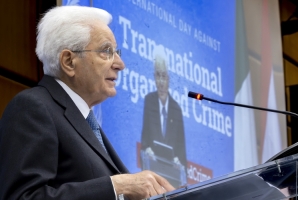
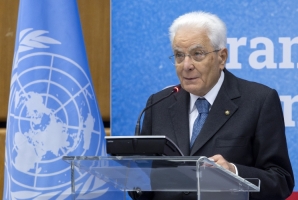
I am delighted to be speaking at the opening session of the Day for the Prevention of and Fight against All Forms of Transnational Organised Crime.
A day instituted by the General Assembly, with Italy giving momentum to such a decision.
I wish to draw your attention to the importance that Italy attaches to three anniversaries occurring in 2025: 80 years since the founding of the United Nations; 70 years since Italy joined the UN; and 25 years since the signing of the UN Convention against Transnational Organised Crime, known as the Palermo Convention – which is something I recall, for I was there on that occasion.
This clearly illustrates, should it be required, the great value multilateral diplomacy embodies, as well as the patient and orderly construction of international institutions tasked with supporting the progress of humanity.
Allow me to offer some sobering thoughts on each of these three moments.
In 1945, the conclusion of the San Francisco Conference and the adoption of the United Nations Charter brought hope to a world that had twice, in the same generation, weathered the devastating fury of global wars. That’s when the construction of an international architecture based on shared rules and peaceful cooperation between states, all equally sovereign, actually began.
Over a span of 80 years, the United Nations has been a driver of crucial progress, from decolonisation to supporting the social and economic development of billions of people, from peacekeeping operations to upholding human rights and fundamental freedoms.
Today, the UN is still the fundamental framework for addressing challenges that transcend national borders: the promotion of a shared agenda for safeguarding our planet, the challenges posed by Artificial Intelligence, the protection of global health, just to mention a few. Organised crime falls into the category of challenges that call for a constant and coordinated international response.
This long journey has not been free from obstacles, mistakes and shortcomings, partly owing to structural deficiencies within the Organisation and partly because of the fluctuating political will of member states to fully support its actions.
The recent UN80 reform, launched by Secretary-General Guterres, was taken up to respond to this call for greater effectiveness.
It is a step in the right direction, but it calls for broader analysis of the UN’s decision-making mechanisms themselves, starting with the Security Council, whose configuration – and powers vested in the permanent members – reflect the world of 1945.
The UN can only fulfil its mandate as guarantor of international peace if its member states allow it to do so. Nevertheless, despite such limitations, the United Nations remains an extraordinary and irreplaceable instrument of peace and stability. Weakening it would be reckless.
The geopolitical situation we are facing, from Russia’s ongoing war of aggression against Ukraine to the crisis in the Middle East and instability in several regions of Africa, often compounded by dramatic humanitarian crises, clearly requires the active support of the UN, certainly not its dismantling.
I am thinking, for example, of the need to strengthen – and not demolish – the architecture concerning disarmament and the non-proliferation of nuclear weapons, at a time in history when we are instead witnessing unacceptable allusions to the use of weapons of mass destruction.
There are no alternative options to multilateralism, unless we are prepared to embark on a path of permanent conflict, hence returning to a primitive vision of relations between peoples, whose outcomes are historically and tragically well known.
Regarding the second anniversary – Italy’s accession to the United Nations – I would like to point out that while the UN was being created, Italy was embarking on the path towards a new fundamental law, the Republican Constitution of 1948, based on values that concur with those of the San Francisco Charter and the Declaration of Human Rights.
In that text, the far-sighted Italian founding fathers clearly indicated the path for Italian participation in international organisations.
On these grounds – namely, full compliance with a system of values – the Italian Republic was able to join the United Nations in 1955, the same year as the Republic of Austria.
Since then, Italy has been a steadfast supporter of campaigns that promote universal values, hosting important UN structures on its territory.
In this regard, allow me to express my heartfelt thanks to the country that hosts this important UN centre, and to you, Mr Federal President – and dear friend – for being here today to support, together, the very values that have underpinned our shared 70 years of membership of the UN family, in ethical and political terms.
This shared vision – and I’m moving to the third point now – also includes the Palermo Convention.
A Convention that was also strongly supported by Italy, which had suffered moments of arrogant aggression from organised crime.
The bloody attacks of 1992 that claimed the lives of Giovanni Falcone, Francesca Morvillo and Paolo Borsellino, along with their valiant and courageous bodyguards, are still etched in the collective memory – among other things.
Falcone and Borsellino – whom I had the privilege of knowing and often meeting – had dealt the Mafia very effective and successful blows, exposing its financial networks, connections and social weaknesses.
It was the dawn of a period characterised by new investigation techniques, such as seizing and using the vast resources of organised crime for social purposes.
Those attacks were the final act of an arrogant Mafia, which thought it could challenge the state, but was, instead, defeated.
Organised crime can indeed be defeated – provided that institutions and the various branches of society acknowledge their shared duties of civic responsibility.
This goes both for national contexts and supranational levels.
After all, how can we think or expect to combat transnational criminal activities in a different and successful way?
Giovanni Falcone understood how important international cooperation was as a means for combating organised crime: from illicit trafficking to the transfer of criminal proceeds for reuse and laundering.
Backed by this conviction, Falcone led – in this very building, as the Director-General pointed out earlier – the Italian delegation to the first session of the UN Commission on Crime Prevention and Criminal Justice in 1992, a few weeks before being murdered.
His vision was then shared and further developed, thereby leading to the work on and drafting of the Palermo Convention.
Ladies and gentlemen
Today, here in Vienna, we solemnly renew our commitment to fighting organised crime.
This is a common moral duty of the international community on the whole. A duty that must unite it.
The Palermo Convention, with its Supplementary Protocols, stems from the very awareness that the phenomenon of transnational crime, like all other global challenges, can only be tackled with a broad coalition of forces.
This is why still today, 25 years after its signing, the Convention is so topical – to the point that it challenges us severely, given the results it has achieved in terms of the moral tension, the sense of duty and the determination that Giovanni Falcone associated with the very dignity of the individual.