
percorso pagina
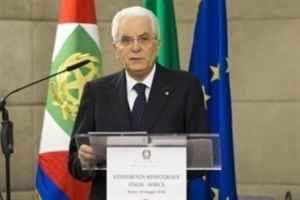
Address by the President of the Republic Sergio Mattarella at the opening session of the firts Italy - Africa Ministerial Conference
Distinguished Ministers, Commissioners and Representatives of the United Nations and International Organisations,
Ambassadors,
Ladies and Gentlemen,
I am very glad to be here with you today at the inauguration of this first Italy-Africa Conference.
The presence of so many distinguished representatives at this event is a sign of the positive response to Italy's invitation on the part of the countries of the continent, the African Union and the United Nations and all its agencies.
Our hope - both simple and deeply felt -- is for us to engage in an even more intense and structured dialogue.
We must be grateful to you, in particular, for this opportunity but I also wish to acknowledge the genuine passion which Minister Gentiloni has shown, with his aides, to make this valuable opportunity for discussing and sharing views possible.
Our goal is an ever closer and comprehensive relationship between the African continent and Italy.
We are well aware of the many and complex challenges facing us.
However, we are sure that this meeting will give strong impetus in this direction.
For some time now we have been living in a changed international situation.
Even more than in other ages of history the globalization process has increased the bonds between Africa and Europe.
The current crises have led to an awareness that the fates of our two continents are even more interlinked.
While globalisation has reduced geographical distances, crises have made borders permeable.
Finding solutions to our common problems has become a common endeavour.
This, however, does not mean denying that there are differences between Africa and Europe, just as there are differences within the two Continents.
These, however, should not overshadow a basic and unavoidable requirement: our political agendas have to be made mutually consistent and as effective as possible.
The world in which we live is too interconnected to allow us to ignore events that occur near to us, both when they present opportunities or challenges.
Africa, in any case, is not and can no longer be something which is "other" from Europe. And vice versa.
That vision is outdated and definitively relegated to the past.
There are common causes which call upon us to act:
- first and foremost, the cause of peace and the fate of humanity;
- the need for an all-out war on terrorism and all forms of fundamentalism;
- the need to allay political tensions in hotspots;
- the need to eradicate scourges - such as hunger, famine, endemic diseases and infant mortality - the existence of which is unjustifiable in the light of the knowledge which we have by now acquired;
- the intelligent governance of migration as an epochal rather than temporary phenomenon;
- the need for economic and social policies which can sustain economic growth and employment;
- the battle against corruption which is a drain on major resources and hinders development.
These are the many challenges facing us today, common challenges that we need to face up to immediately, because tomorrow will be too late.
I therefore am greatly confident about the results that the common reflections which begin here today will bring.
For us, as is always the case when bold responses are sought, this provides us with a unique opportunity in view of the roles which our countries can play and the consequences which our actions will have on new generations.
We have the duty to fully explore the extraordinary potential for development of relations between Africa and Europe and we already have all the tools we need to jointly exploit the opportunities before us.
This conviction was further strengthened during my recent visit to Africa - to the Sub-Saharan region - and to the African Union.
I became aware of extremely interesting signals for a strategic partnership, for the possibility to deal together with the situation we have before us, definitively discarding stereotypes and obsolete mind sets.
More specifically, I was able to appreciate the full awareness that the African continent has of the active and dynamic role it can play in seeking solutions to global challenges.
Africa is increasingly playing a leading role in politics, in the security architecture as well as the international economy, also thanks to the driving role of regional Organisations and the African Union.
In particular, I hope that the African Union as heir to the Organisation of African Unity, whose 53rd anniversary we will be celebrating in a few days' time, will continue, together with other regional Organisations on the continent, to be a multiplying factor for peace, security, prosperity and social cohesion in the forms and ways that are most suitable for the context in which it operates.
***
Ladies and Gentlemen,
Italy, in view of its geographical position, because of its history and culture, is a bridge between Africa and Europe.
A bridge which has no prejudice and is respectful of the specificities of its interlocutors and which is open to a practical and sincere dialogue.
Our country, with its various facets, has turned these features into a distinctive hallmark of its policy towards its African partners and has done so with commitment, with dedication and with the use of substantial resources.
It has done so not only through public funds and private entrepreneurial activity, but also through the many NGOs which can draw on human energy and material resources from the dense network of voluntary organisations, which represent a basic feature of Italy and its people.
I am sure that from today's proceedings - which will focus on the various facets of the increasingly crucial concept of sustainability - a clear indication will emerge of the scope of the contribution which Italy can and will make to the dialogue with your countries and with the African continent as a whole.
Education, training, the acquisition and best use of skills for the population, particularly women - whose potential is still largely unexpressed - and young people represent goals towards which we can work together in a common pursuit of sustainable and inclusive development.
I think that the kind of sustainability we should aim for as a priority - as the experience of EXPO has shown us - should be overarching: economic but also social and environmental.
The need to reconcile growth with the sustainable distribution of resources is - and rightly so - at the centre of the development paradigms which have been devised by the United Nations and the African Union with the "2030" and "2063" Agendas, and must be the main road towards the goal which we need to pursue in Italy, in Europe and in Africa.
With regard to economic sustainability, I believe that worthy of attention is the good performance of our industrial sectors, Italian SMEs and cooperatives, but in particular, the characteristic capability of our economy to combine the human factor - the driving force and the goal of every development process - and environmental protection together with new technologies. This is the keystone of an original path which, in conjunction with all stakeholders, can enable us to identify the potential for development on which we can focus so as to establish realistic, concrete and verifiable goals.
This is also one of the intended goals underpinning the recent reform of the Italian Development Cooperation policy aimed at establishing a system which looks beyond a traditional aid policy.
In this area, Italy is ready to do its part, to create economic opportunities and jobs, with a special focus on women and young people.
A very useful role as part of this integrated vision can be played by the private sector, which needs to be appropriately involved in this process with a renewed commitment to combine the requirements of profit, development opportunities, including social development and environmental sustainability.
The improvement of food security and nutrition, strengthening basic health and education services, protecting the most vulnerable groups in the population and the development of a micro-entrepreneurial system all depend on this approach.
Such a longer-term vision, however, should not make us lose sight of current emergency situations and of our duty to manage the crises triggered by climate change, high food vulnerability due to famine and instances of conflict and instability.
Ladies and Gentlemen,
the growth and integration prospects which I mentioned depend on finding a solution to the phenomenon of migration and the refugee crisis which I described as 'epochal' previously.
Faced by an event which has so many consequences we cannot simply focus on solutions which provide containment alone.
We need instead to consider and discuss approaches of a global nature which are not just linked to urgency, but which can lead us towards lasting solutions.
No-one wishes to abandon their homeland and their loved ones, , particularly when this entails the unknown venture of undertaking a dangerous journey and arriving in a remote and different society.
And therefore it is up to us to ensure that we can dispel the despair which leads people to leave their homes, in order to promote well-being and stability so that these can become the most effective barriers against migration.
This is a goal shared by Africa and Italy, by Africa and Europe - and allow me to re-iterate this- within the African continent, too.
Being able to mitigate malaise, making it possible for people who have been the victims of calamities and conflicts to find temporary asylum in neighbouring areas, are desirable goals.
Mass migration for the African continent is the most painful deprivation of the future of our time: millions of people fleeing their homes impoverish African civil society and represent a terrible toll paid to disorder and tyranny which will be a weight on development capabilities themselves.
Despite the extraordinary progress made recently further effective efforts are needed to eliminate the root-causes of migration caused by need.
As we know, Italy has constantly advocated the need for strategies which go beyond a simplistic response to this phenomenon based on the building walls and barriers.
The first duty is to save human lives and give relief to those who are suffering and struggling.
We should never ever forget- and Italy has never done so - that underpinning our actions there should always be the principle of the protection of human life and the dignity of every human being.
Migration needs to be dealt with through a multi-dimensional approach which combines the management of emergencies and the subsequent elimination of the causes which lead so many people to leave their homes, as well as- where necessary- integration.
It is in this perspective that Italy has presented to the European Union a document for discussion, entitled the "Migration Compact", which aims at dealing with all the aspects of the migration phenomenon.
We believe that Europe has the duty to contribute to the stability of Africa, and that this is a priority for the European Union as a whole. The process begun with the Valletta Conference needs to be continued with determination.
For only through renewed political, economic and financial endeavour will it be possible to work towards creating the conditions which will bring about a stable reduction in migratory flows .
This approach requires partners - individual countries and regional groupings - which show a commitment of the same intensity and which share the same concern for a situation which seems to have become out of control, in countries of origin, transit and arrival, but which on a daily basis continues to separate people who are linked by emotions, to disrupt people's lives and to cause pain.
The path towards a full sharing of this approach is the only one which we believe can deal with the challenges before us; it is a complex path, but we do not intend to stray from it.
A path made of mutual commitment, trust and of stages which we must traverse together .
Ladies and Gentlemen,
allow me, before I officially open the proceedings of this first Italy-Africa Conference, to offer you one final remark to reflect on, again predicated on the value of sustainability.
The safety of people's lives and their communities is being tested by a looming threat, which is insidious and cross-cutting: that of terrorist fundamentalism. Violent and minority forces are taking entire populations as hostages.
The gruesome list of cities which have been the victims of barbaric assaults - including cities such as Bamako and Bruxelles, Maiduguri and Paris, Tunis and Touluse, Garissa and Ankara - can only remind us that terror knows no boundaries and that it is fuelled by division, fear and instability, in the shadow of which it spreads.
The commitment of the countries that are most exposed to the fundamentalist danger, together with the African Union and the regional organisations, has brought about an intensification of cooperation against terrorism.
As terrorism knows no boundaries, cooperation between countries and the forces which strive for the respect of the dignity of people and their freedom should also be convinced and effective.
I trust that through the practical contribution of Italy - which is staunchly convinced of the need to strengthen Africa's security sector - by means of bilateral and multilateral initiatives - new forms of cooperation between Africa, Europe and the United Nations can be explored.
Strengthening the law-enforcement and security measures which police forces in co-ordination can deploy, is an important part of the solution but this cannot be the sole antidote to fundamentalist violence.
It is necessary to combat the 'subculture' underpinning fundamentalism, by addressing its root causes and the economic and social tensions, such as the lack of access to training and education on the part of young people, and the social exclusion which continue to affect women in particular.
Social cohesion and the certainty of a future in which a decent life can be lived are the best ways to combat terrorist fundamentalism, and this is the idea which should guide our action.
Basically it is necessary to invest in the cause of peace.
Ladies and gentlemen,
in the full awareness of the need to deal with these issues increasingly 'together' - Africa and Italy, Africa and Europe - I reiterate my best wishes for a fruitful meeting in the hope that your reflections can help us not only to deal with our challenges jointly, but also to grasp the opportunities before us.
Rome - Farnesina, 18/05/2016 (I mandato)
Altri elementi
-
Intervento del Presidente della Repubblica, Sergio Mattarella, in occasione della sessione d’apertura della I Conferenza ministeriale Italia-Africa
-
Intervention du Président de la République italienne, M. Sergio Mattarella, à l'occasion de la session d'ouverture de la I Conférence ministérielle Italie-Afrique
