percorso pagina
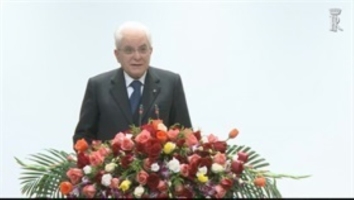
Lectio Magistralis by the President of the Republic Sergio Mattarella "Fudan" University of Shanghai "The New Silk Roads"
Distinguished President Xu,
Academic authorities,
Dear students,
Ladies and Gentlemen,
I am particularly happy to be your guest in this prestigious academic Institution and I would like to begin by thanking you for the specially warm greeting extended to me and to the delegation accompanying me.
The visit that I am carrying out, upon the invitation of President Xi, is getting me acquainted with the infinite and fascinating aspects of a Country that - across the millennia - has and continues to represent one of the load-bearing structures of the world's cultures and civilizations.
The Chinese culture - we should always keep in mind - is the culture that the West came to know even before the first journeys that characterised the era that we, in Europe, conventionally define as the epoch of "great discoveries", which later led to the colonisation of the Americas.
The civilizations of Europe and China came into contact long before that.
They came together thanks to what was defined at the time as the "Silk Road" or, more precisely, through the many roads that, in one or the opposite direction, enabled trade and fuelled the yearning for knowledge and reciprocal curiosity and, with them, nourished a growing osmosis between two universes kept afar by distances that - up to not so long ago - appeared - and actually were - almost unsurmountable.
Diplomatic missions and legations, Italian and Chinese, succeeded each other through reigns and nations.
Geographic reasons contributed to making the encounter between these two worlds - through long centuries - little more than sporadic, restricting it to the epic of big naval or commercial endeavours undertaken by travellers who came to be famous and some of whom - as we know - came precisely from Italy.
This state of affairs - in the illusory conviction of one's centrality in the world - for centuries nourished the curiosity of the West for far-away territories and peoples, which were imagined to possess immense riches, eminent and mysterious personalities, fascinating religious creeds different from those known.
These contacts - hindered by the difficulty in communications, also later - waned over time, until they were almost lost for several generations, and re-emerged in the wake of a new great journey, of new objects from these areas of the world, of new stories.
Curiosity therefore and, with it, the insuppressible yearning to contact "other" people, sparked off again.
Of these episodes, these moments of coming together and understanding, remain extraordinary legacies, such as the Nestorian Stele, the memoirs of Marco Polo and the translation of books considered to be fundamental in China and Europe, edited with friendship and passion, by Matteo Ricci and Xu Guangqi.
This periodic reciprocal rediscovery, this pacing of relations between our Continents, this alternation between periods of vivid interest and long pauses - almost moments of oblivion - is an aspect on which we should dwell. It is worthwhile to do so because it can not only help us to better understand the reality and the topicality of our relationships but also, and mainly, to instruct the future.
The risk of "losing each other", resulting from the lack of full reciprocal understanding, of taking for granted our familiarity with each other, resulting from our lingering in underestimating the other's positions, constitutes an unknown factor - effective and not only potential - in the relations between China, Italy and Europe.
It is not a risk relegated to the past, when technology did not make it possible to "bridge" distances and the mastery of foreign languages was the dominion of a very restricted few, indeed of a small elite.
It is an unknown factor that is still very present today and should not be underestimated.
The size of our planet has grown smaller in terms of the capacity of communication and movement: it's true, and a journey from Shanghai to Rome is no longer the subject of a literary epic, especially if it is preceded by a virtual online navigation.
This however is not enough: it is not enough to meet and spend time together. Because it is not only people who have to dizzily move at the pace of real-time communication. It is not only the political spheres that have to work cooperatively and synergistically. It is not only the markets that have to assure a constant connection between our production systems.
It is rather our cultural spheres that have to actually and constantly interact.
It is necessary that the "Silk Roads" multiply and that the roads towards knowing each other better - which are never enough, never sufficient, never ending and never entirely achieved - be deepened.
We need that the "Silk" component of past millennia be converted into the many goods - material and immaterial - that China, Italy and Europe can exchange.
For our cultural spheres to achieve an ever-greater and irreversible integration, we need to build a stable basis for dialogue, in such a way as to continuously reinforce and enhance it.
We need for our two Countries' public and private institutions - and primarily academic institutions - to enhance, with renewed care and passion, the quantity and quality of our cultural relations.
Fudan University, I am particularly happy to say, has fully understood these needs and has thence purposefully taken this path, actively cooperating with some of Italy's most important universities.
The students who are with us today live and work in the modernity of one of the most dynamic metropoles in the world and are naturally projected into the future, like their Chinese colleagues who study in Bologna, Rome or Milan.
Our communities of students are the surest guarantee that our Countries will never again "lose contact" and, on the contrary, will become increasingly interdependent, albeit in the full respect of the characteristics of our two peoples.
Dear President Xu,
Academic authorities,
Dear students,
The coming together of peoples is at the core of my State Visit to the Peoples' Republic of China.
One of the goals of my trip is the aspiration to contribute to give new impulse "across the board" to the relations between our two Countries.
A consolidated, lasting and fruitful bond cannot be limited to the albeit essential economic sphere. It maintains its relevance intact and has greatly contributed, especially during the last few years, to an unprecedented exchange and integration between our companies and production systems, opening a new and particularly promising phase in bilateral economic and commercial relations.
However, our task is still broader.
In order to protect the inestimable value of our relations from the unpredictable, and oftentimes turbulent, vagaries of markets alone, we need that they be based on even sounder foundations, built through ever-closer institutional and political relations, that we hope will materialise also through periodic top-level Government meetings.
This will provide the framework within which to pursue even tighter and qualified commercial ties, ever livelier cultural exchanges and opportunities to compare our lifestyles, enabling a greater integration in our ways of thinking and of relating to each other.
The opening in Beijing of a joint session of cultural and economic forums goes precisely in this direction.
I hope that, in the years to come, other forums might be added to these uniting - for example - the points of excellence in the sector of research and innovation.
Our Universities - authentic "motors of knowledge" of our societies - can make an invaluable contribution in this direction, by helping to make a "system" out of the intense network of existing inter-university agreements; a system at the service of the development of our Countries and of our societies.
We must repropose a "New Silk Road" in which this new fine fabric - once joining the rarest and most precious goods - be replaced by knowledge, an even more valuable good that, unlike silk, we hope will not remain "rare" but become increasingly available to everybody.
This is the way we can contribute to updating the concept of the "New Silk Road".
In this sense, we cannot but applaud China's "One Belt, One Road" initiative, which is due to constitute a new, important axis in the relations between our Continents.
We appreciate the strategic significance, in the present international scenario, of a route across territories and borders connected by a ribbon of cooperation and knowledge, overcoming diffidence and being instead stimulated to achieve further goals.
Italy will participate with firm belief in this ambitious project, knowing that its success will not only be measured through the capacity of transferring ever-larger volumes of merchandise more efficiently and speedily.
It will above all be measured through the contribution made in drawing closer together and making more open to each other, the Institutions, societies and citizens of the different Countries involved, also in terms of ideas and values, albeit fully respecting each other's traditions.
It is a great opportunity of liberty on the way towards the progress of humanity: opening up to globalisation as the vehicle of rights and the instrument to combat social injustice.
China and Italy, the Far East and the European Union together can write a new page of history, after East and West and North and South, which were once counter-opposed, gave way to a multi-polar world in which the capacity to aggregate is what makes the difference.
This is the "connectivity" we need, in the awareness - supported by the historic evidence of the original "Silk Road" - that people are the biggest asset in a mutually beneficial reciprocal enculturation process capable of making the relations between our Countries - and our Continents - increasingly stable.
Dear President Xu,
Academic authorities,
Dear students,
We hope that our relations may be grounded on ever-stabler bases because we are convinced that it is precisely stability that international - and not only bilateral - relations most need.
China and Italy, despite their peculiarities, are particularly close from this point of view. Indeed, our Countries aspire to a system of relations - at global level - based on a greater integration between economic areas and on open and dynamic economies and societies capable of fostering global growth.
Beijing and Rome alike perceive with equal apprehension different signals such as the slowdown in the growth of international trade volumes.
The concern is fuelled by the progressive onset of a climate of feebler cooperation, at international level, which is in net contrast with the awareness - which I referred to earlier - of a world that has become "smaller".
This circumstance should spur us towards an even more intense international cooperation than in the past, instead of shying away from it.
Today's major problems - migration flows, climate change, an efficient management of the global economy with a focus on the social transformations induced by demographic changes - require a renewed commitment by all the international players towards a greater and more fruitful understanding of the challenges that we have before us, some of which are truly epochal in nature.
Neither we - nor anybody else - can think of tackling such overwhelming problems without a joint effort. Nor can we risk that our international relations be shaken up by "trade wars" triggered by actions and reactions.
A similar scenario would have no winners but only losers. And the first to suffer the consequences would be the people.
Rather, we feel the need and duty to proceed in the diametrically opposite direction.
We feel the need to be more open to dialogue and for greater mutual understanding.
This is the only way we have of imagining to overcome the difficulties of an economic cycle that is complex to say the least, and which will undoubtedly be easier to overcome through coordinated action rather than pursuing disorderly and frenzied unilateral actions. The experience of the European Union confirms that the sum of the capacities of single States is greater than the single parts that comprise it.
In this sense, we heard with great interest the positions recently expressed by President Xi Jinping at the Davos Economic Forum.
We especially agree with the wish to give added momentum to international governance processes in order to make them fit to govern a globalisation in which inequalities - not only between Industrialised and Developing Countries but also within politically, economically and socially homogeneous areas - risk bringing global order close to the breaking point.
In this sense "effective multilateralism - meaning thereby a working method with which to address international issues always and primarily through a constructive dialogue between the parties concerned - represents a principle that Italy has never failed to tangibly support.
This is the approach that our Country is taking with respect to its Presidency of the G7 and to Italy's presence on the Security Council.
We must work intensely to find solutions to counter the tendency towards involution, closing up and unilateralism.
Our aim can only be that of achieving a fairer distribution of the income produced, consequently reducing inequalities, stimulating growth in Countries with weaker economies and thus making it possible, for example, to reabsorb the otherwise growing and inevitable phenomenon of mass migrations.
These are the goals that guide Italy's action within the European Union and that we intend to reaffirm, in a few weeks' time in Rome, when we will celebrate the 60th anniversary of the Rome Treaties, in the conviction that the European integration process has brought to our Continent peace, prosperity and rights, in a dimension and scope unprecedented in its history.
China and Europe must be able to look to each other much more than in the past in order to establish increasingly stronger economic, commercial and financial relationships.
The different sensitivities that arise are part of an inevitable dialectic which must nonetheless constantly prelude to the achievement of balanced and forward-looking political solutions based on mutual respect.
The period that we are experiencing, with its undeniable turbulences, is also a period of great opportunities that China and Europe can certainly be able to grasp by working in favour of peace and of the stability of international equilibria well beyond their own borders.
Dear President Xu,
Academic Authorities,
Dear students,
The days that I am spending in China are making me more fully understand the breadth of the relations between our two Countries and their further potential.
Both are rooted in an age-old and fruitful past.
And it is on this past and on the new Silk Roads that we can build an even more promising future.
To achieve this, we need everybody's commitment and participation.
You students represent our best hope for a future based on understanding, peace and wellbeing for our two Countries and for our people.
I therefore call on you, recalling the thought of Guan Zhong, the ancient Chinese statesman according to whom the success of a one-year project needs good seeds, a ten-year project needs to plant trees and a one-hundred-year project needs to grow talents.
You are the talents. It is upon you, who are our talents, that we have entrusted our future.
Shanghai , 24/02/2017 (I mandato)
Altri elementi