percorso pagina
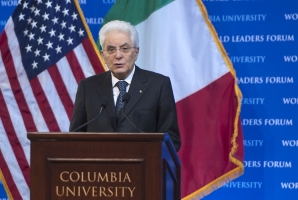
Lecture by the President of the Republic Sergio Mattarella at Columbia University: "Leadership in the Age of Change: Managing Current Development In the Mediterranean through Europe"
I wish to begin by thanking Professor Bollinger, the President of Columbia University, for giving me the opportunity to take the floor today, before you, on the occasion of my first visit to the United States as the President of the Republic of Italy.
In today's world the concept of leadership is associated almost automatically with a condition of solitude: in other words, the exercise of leadership seems solitary. Uncommon talents and abilities allow an individual to guide a process, to point to a collective goal, in solitude. And it is up to others to recognize and follow that process.
This reading is based on the vertically-organized power typical of a society in which citizen participation is replaced by processes of periodic delegation, and in which decision-making is shaped by polls that both reflect and influence public opinion. In a liberal democratic system, the difference consists not only in the effectiveness of the results, but also is the way that goals and leaders are chosen. That is to say, there is a two-fold process of legitimation that characterizes the exercise of leadership, which is supposed to be the expression of a "common conscience."
Honoring a leader therefore means assuming responsibility for political action undertaken on the basis of shared values and principles.
Leadership is not an abstract condition: it consists in knowing how to meet the challenges set forth by reality.
At the international level, two devastating world wars have helped define a community of values and shape a form of leadership that, subsequently, have lead the two shores of the Atlantic to weave a special friendship and forge common long-term views on the great international issues. This community of values was consolidated also thanks to an essential pillar of our relations, the Atlantic Alliance, envisioned and established to assert the values of freedom and democracy.
In an international dimension, leadership thus signifies an ongoing commitment to asserting and defending the values that we believe should be at the heart of the peaceful coexistence, prosperity and progress of humankind, by which I mean both individuals and the social, cultural, religious and political "groups" to which individuals belong.
Our Countries, our "family" of Countries, have developed an approach that has profoundly affected the way international relations are arranged and that continues to represent the true essence of what we still wish to share with the international community as a whole today.
Western leadership makes an indispensable contribution to the management and resolution of the crises that the world is facing with greater frequency and intensity. Yet that leadership is called upon every day to reaffirm its ongoing commitment to these values, to personify them in a changing and demanding reality, the clearest sign of which is terrorism, ever present in our daily lives; the historic dimensions of migratory flows, and, finally, the emergence of new crises and the aggravation of age-old tensions in the Mediterranean region.
These are questions of paramount importance to the United States, to Europe, to Italy.
Crises that can and must be overcome on the strength of our values, the ultimate goal as well as the basis for and limit on our action. In this sense the illuminating words of George Kennan at the end of his famous long telegram could not be more relevant: "Finally we must have the courage and self-confidence to cling to our own methods and conceptions of human society. After all, the greatest danger that can befall us ...is that we shall allow ourselves to become like those with whom we are coping".
These words, despite the changed international context in which we are living, still hold true today.
But what we cannot afford is to fight instability by renouncing the fundamental values of our society. To do otherwise might allow us to win a battle or two, gaining a temporary advantage, but in the long run we will forget and irreparably fail in our fundamental objective: to guarantee to others an equal measure of the liberty, prosperity and progress that we ourselves can enjoy today. And the right to the pursuit of happiness, so luminously inscribed in the Declaration of Independence of the United States of America in 1776.
This is the universe of values that we must preserve for the younger generations, in the hope that they, too, will work to maintain and improve it.
Terrorism is the most disruptive threat that our societies are facing. A threat that knows no borders, that is fueled by an irrational destructive force and a series of insidious anti-values that seem to have been created as the antithesis of the foundations on which our societies are based.
No continent is safe from the dangerous spread of this phenomenon, which benefits from the perks and instruments of globalization, and is an urgent warning to us all.
It is illusory to think that individual Countries can defeat this scourge on their own. Harsher laws and controls, together with the preventive and police actions that each nation or group of nations may adopt, can only increase and improve defenses: they do not constitute an authentic solution. To fight such a complex phenomenon we need first of all to work together, to do so more often and better, in order to block the genesis and development of terrorism, and prevent it from prospering where our values struggle to be understood and asserted, where respect for human life and dignity is systematically violated.
The first aim of terrorism is to make us afraid, and, subsequently, to condition us.
We will not allow this. We will always and everywhere defend the achievements of our civilization and the freedom of our life choices.
In this sense, the collaboration between the United States and the European Union is an absolute necessity if we are to wage an effective and credible battle. This is a vigilant, trusting, careful collaboration that must always be able to prevent in order not to be left behind, to be too late to address a slippery, insidious threat ready to strike anywhere and everywhere.
A threat that is fueled by instability and that exploits war, poverty and social tensions and holds hostage too large a percentage of the world's population.
Ancient societies are fragmented and unable to set the foundations for new societies.
These - rather than an alleged clash of civilizations - are the main causes for the spread of terrorism and the emergence of Daesh. The threat flourishes wherever there are failed States.
But when this happens, what is doubted and threatened is the model for international relations born with the Peace of Westphalia. What is endangered is the very possibility of building peace.
What Daesh means, in concrete terms, is the negation of every legal framework in which the rights of the person are safeguarded by the supremacy of law; it denies the rule of law, an instrument that can build relations with other States to achieve together the goal of progress for the sake of all humankind.
We have seen the consequences of this savagery before our eyes, in our own cities, and in the images of the barbarous executions of defenseless human beings.
The refugee phenomenon facing Europe in this period is rooted in the same soil: war, poverty, social tensions. We have not witnessed an event of these proportions since the second world war.
In this case, too, short-sighted considerations of mere domestic policy - walls and barbed wire erected for protection and to "reroute the traffic" - will not enable us to manage an event of historic dimensions with no end in sight.
We must not forget that migration is one of the great recurrent events of human history. Fighting it is useless: what we must do instead is govern it. The only possible response is thus a commitment born from a renewed unity of intent on the part of the international community and, with regard to my Country in particular, from closer collaboration between the Member States and the Institutions of the European Union.
As we speak millions of men, women and children are crossing Africa on foot, crossing the Middle East on foot, to escape from death.
The regional organizations, in accordance with the United Nations Charter, are called upon to play an active role. This is true for humanitarian crises. It is also true for the pursuit and creation of larger areas of prosperity.
Europe must be effective in its action.
And it has been, drafting solutions in recent years that helped it to come out of the most acute phase of the economic and financial crisis unleashed on global markets, which cast doubt on the solidity of the single currency and the cohesion of the Eurozone. Europe must know how to be effective on other fronts as well. The assertion of its identity and thus of its fundamental values is the guiding light for every solution.
In numerical terms, the migration crisis that has struck Europe is not comparable to phenomena that have taken and are taking place on other parts of the planet. Every year the United States takes in almost one million new foreign citizens, who continue to find in it a land in which to realize their hopes in life, at the same time as the Country benefits from their presence and grounds its prosperity also in their contribution.
Nevertheless, the impact of the migration crisis on the process of integration on the continent is proving to be more problematic than the recent Euro crisis because of the radicalizing effect it is having on domestic public opinion. A radicalization that empowers the forces of populism and their superficially appealing message, often centered on an anti-historical and unrealistic return to nationalisms that - as history has demonstrated - have no future.
True leadership is knowing how to meet these challenges: it is my fervent hope that also through the migration crisis the European Union may be further encouraged to strengthen its cohesion.
The decision to update the common policy on asylum and on strengthening external border controls is a step in the right direction. But we will need an even larger dose of leadership from the European Heads of State and Government, to move from emergency solutions to long-term structural improvements that respond effectively to this crisis, cushioning, with far-sightedness, the possibly destabilizing effects inevitably carried by migratory phenomenon. And to assure that this is a valid and lasting response, we must not forget that we are dealing with persons whose integrity and dignity it is our moral duty to safeguard.
One of the areas in which the European Union - in light of the current international situation - is called upon to show more cohesion and leadership is in foreign policy. This brings us to the crises unfolding from the Mediterranean to the Middle East.
Some signs indicate that here, too, progress is being made and greater European cohesion can produce positive results.
I refer first to Libya, where the compactness of European diplomacy around the action of the United Nations has led to a preliminary agreement for the reconstruction of shared national institutions. This is the first step toward bringing the Country under the control of stable, credible central institutions. Launching effective peace, stability and development policies means drawing the lessons learned from the international community's intervention and then applying them.
The dramatic vicissitudes of the Balkans attest to this. The responsibility taken on by the international community, the United Nations and the European Union have with difficulty but success launched a major process of pacification and gradual inclusion in regional bodies of Countries emerging from the break-up of the Yugoslavian Federation, thereby offsetting the risk of renewed conflict.
These are processes that must be initiated with respect first and foremost for the peoples affected, for the global promotion of democratic values.
The crisis has also led the European Union to reopen its strained channels of communication with Turkey.
The dialogue between Ankara and Brussels has the purpose of keeping open the prospect of a gradual accession of Turkey into Europe - in full compliance with EU standards - and of strengthening our cooperation with a Country that is strategic to the stability of the entire area.
Lastly, owing to the migration crisis, more intense talks have begun between the European Union and the African Countries. This dialogue is essential to mutual stability and to the development that the EU and African Countries are called upon to consolidate and to which they must remain actively committed. Assistance to Countries from which migratory flows originate must be greatly intensified to improve their socio-economic conditions - as a first crucial step toward curbing the phenomenon. This, in addition, of course, to our duty of showing solidarity toward Countries in difficulty.
Beyond these positive developments, we must not, however, forget that the main source of instability at Europe's borders comes from a political, economic and institutional arrangements in the Middle East for which, in addition to violent new crises, there has yet to be a satisfactory balancing point, starting with the Israeli-Palestinian question.
A strong unity of intent among the Atlantic Allies is indispensable to building on convergences - especially in the Syrian-Iraqi scenario - with other stakeholders, such as the Russian Federation and Iran, in order to more rapidly stabilize a conflict fueled by all of the main tensions in the Region: clashes between interpretations of Islam, between central and rebel powers, between calls for democracy and autocratic regimes, between transparency and powers vulnerable to corruption.
The international community's difficulties in bringing to a close interminable negotiations on low-intensity conflicts, as well as the Iraqi and Syrian crises, have created fertile ground for a resurgence of ancient ambitions of regional supremacy - a further destabilizing factor.
The ongoing conflict in the Gulf region is only one example, at an economic juncture in which the low cost of raw materials makes the economic future of many Countries in the area more uncertain than it was only a few years ago.
Especially for the sake of the peoples of the Region, who continue to be victimized by a crisis that in a few short years has generated millions of refugees, the international community must take concrete, immediate action, based on a long-term strategy that will create a new lasting balance among all of the stakeholders.
This is why we must consider for a moment the genesis of the great hopes raised (and mostly disappointed) during the period we call the Arab Spring. The just claims that propelled these movements were borne of the authentic need for better protection of individual rights and freedoms, including the right to employment, to a dignified existence for oneself and one's family.
In addition to material reconstruction, we need to plan the necessary reconstruction of the social fabric, devastated by conflicts.
We can defeat terrorism and Daesh by deploying a wide range of tools: from the use of force to cooperation with our allies in the region; from pressures on the parties to a conflict to sanctions; but especially by offering a future of hope.
There will always be an "after," and it is during this "after" that we should continue to work to assure the rights and protections that so many Syrians, Afghanis, and Somalis hope to attain by emigrating to Europe, risking their lives and - what is even more important and terrifying - the lives of their children, who, far too often, drown in the Mediterranean.
This is a question that I have already addressed in another part of this conversation.
We are living a particularly complex moment in which, for the first time since the end of the cold war, Europe is confronted by a two-fold challenge.
Within Europe, the integration process that only a few years ago reached its zenith with the launch of the single currency is slowing down both in terms of completing the structures for economic governance and in terms of the free circulation of its citizens.
At the level of the external threat, the foreign and defense policy of Europe and of its member States often overlap, and not always in a consistent manner.
Here, too, we have reached a transitional moment, with common structures that are developing but that still need time to be established definitively. The weight of these crises, however, demands immediate responses.
There are many who believe that today's crises have ushered Europe into a period of distrust in its ability to promote a design that is shared among its peoples. The difficulties are not insurmountable. Instead we must work to transform them into a positive force for greater and better integration. Jean Monnet, one of the founding fathers of the European Union, often asserted that, and I quote, "Europe will be forged in crises, and will be the sum of the solutions adopted for those crises."
His words have not lost their relevance. Renewing its forces - and thereby also renewing its leadership capacity - is a duty for the European Union.
In 2015 we celebrated the 70th anniversary of the end of the Second World War and commemorated the centenary of the start of the First World War: two global tragedies from whose immense suffering the idea of Europe was born, grew and took root; a Europe that would unite rather than fight, a project to whose inception the United States of America made a decisive contribution.
The United States, at different moments of its history, has taken on a fundamental leadership role at the head of free Countries.
Washington's leadership - whether through President Woodrow Wilson's 14 points or the 1941 Atlantic Charter signed by President Franklin D. Roosevelt and Winston Churchill - has been decisive in creating a more just international order.
The support of the United States was crucial after the conclusion of the Second World War, in helping to find a new European balance, endorsing the ideals of visionary leaders such as De Gasperi, Adenauer, Schuman and Monnet, Spaak and Spinelli.
The European Union is the end-result of a long vital process. Its progressive integration has allowed Europeans to live a truly unique period of peace and social, cultural and economic development, and to create an area of attraction that has become precious, as demonstrated most recently by the events that ensued after the fall of the Berlin Wall.
This history has produced rights and increased protections for all. It has generated security and offered a model of pluralistic coexistence.
These are accomplishments that we must not sacrifice.
In the multi-polar world in which we live, the Atlantic Partnership continues to be an essential point of reference and, in this framework, Europe must shoulder its responsibilities. In this context the European Union cannot succumb to the temptation to weaken its cohesiveness. The elements of instability on its borders demand, on the contrary, a strengthening of active neighborhood policies, of foreign and defense policies. They demand the activation of fruitful collaboration with the regional organizations on the African continent to achieve a common future.
Today the United States and the European Union, the tran-Atlantic community, are being asked to demonstrate leadership that is true to their common tradition.
In this general framework, Italy is operating consistently according to the basic principles that inspire its foreign policy - advocacy of Europe, of the Atlantic Alliance, of multilateralism - to address and help solve the problems we are facing, with conviction and a pro-active spirit.
Italy is going through a period of both political and economic chnage.
After years of debate, the Parliament is about to approve an important reform of the Constitution that will turn the Senate from a second political Chamber - with the same attributes as the Chamber of Deputies - into an Assembly that represents the Regions and local authorities.
In the past few months other important provisions have entered into force: a major reform of the labor market; a reform of the educational system; a reform of public administration that is gradually being enacted, which will increase the efficiency of the state apparatus; an improvement of the taxation system that aims to reduce tax evasion and avoidance, strengthening relations between citizens, businesses, and the State; a reform of the social security system and the partly-realized reform of justice.
These are steps that are enabling a significant recovery of efficiency and competitiveness in our Country, whose economy has not coincidentally returned to growth in 2015 and - according to the most reliable forecasts - will consolidate this growth in 2016.
Even in the moments of greatest economic difficulty, Italy never fell short of its commitment to international peace and security.
We are present in all the main crisis areas, from Afghanistan to Iraq, Somalia to Lebanon, Kosovo to the Mediterranean, and in the Horn of Africa, to fight piracy on the Indian Ocean. We are seated at the most important negotiating tables: I am thinking of Syria, Libya, and the coordination of the anti-Daesh coalition.
At the European level, Italy will continue to propose one of the most innovative policies on integration, in coordination with partners who share our vision.
Financial turbulence, political and humanitarian crises overlap in a mix of centrifugal drives that it is imperative to balance and, above all, to govern.
We must be equal to this task, engaging in intelligent and decisive action. And we must do it together, showing the continued relevance of our principles, the courage of our ideas, the force of our democracies, the solidity of our Institutions.
This is the idea of leadership that Italy advocates, a collegial leadership of ideas and values that help, day after day, to bring together in a trusting and fruitful debate our partners and allies, in the daily commitment to the peace, to the stability, and to the prosperity of all peoples.
New York, 11/02/2016 (I mandato)
Altri elementi