percorso pagina
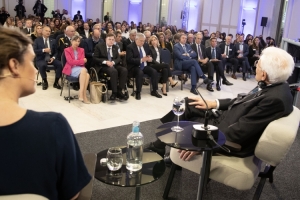
The President of the Republic Sergio Mattarella answers the questions posed by young students at the House of Government in Maastricht
Courtesy translation
Question: What can the European Union do to protect its founding principles against populism, in the name of unity?
President: So, if I’ve well understood, the problem is the pitfall represented by those who do not believe in the Union. You see, the Union is a community of values. Not a simple gathering of States to cooperate in possible economically or even strategically useful efforts. It is a community of values. Without this reference, it would lose its sense and its raison d’être.
In this period, there is a problem with every sphere that concerns communication tools which have radically changed in these past few years. We have witnessed the multiplication of communication tools that providentially facilitate communications.
Your question concerned populism and the pitfalls of disinformation. You see, the tools now made available on the Web and on social media, are an extraordinary opportunity to improve relations and human conditions, as well as the ways of exchanging ideas.
It represents an extraordinary growth and a progress of great importance.
Naturally, as with any discovery made available to humankind, much depends on the use that is made of it. Inevitably, there is also the possibility of making a distorted use of the tools made available by scientific research and by science.
And therefore, it is necessary to combat the disinformation phenomenon that often emerges out of superficiality and the failure to make an in-depth analysis.
All this naturally comprises a problem that shows that between public institutions and the new media, we still lack a mature and adequately consolidated relationship in communicating with citizens through the new tools.
And it is a problem that partly concerns the citizens but prevalently concerns the institutions. We must find a better way of communicating, more closely in line with the new communication tools.
However, I am optimist as to the attitude to the Union because it is assured by the continuous growth of new generations of European citizens that have a deep feeling for this dimension and therefore are impermeable to all forms of skepticism with respect to the European integration process.
We see proof of this precisely in this period. The war in Ukraine is an extremely sensitive and serious issue. In all European Countries, we have been bombarded with fake news circulated by Russia. But these have had a minimum impact on public opinion. A united European Union, with the agreement of all their public opinions, assured its support to Ukraine, which proves that resistance against disinformation is very great indeed. And this induces us to be optimistic.
Question: At present, there is a clear fracture between generations in the general political and civil debate. Young people often have a vision of what the world should be like that is radically different from that of preceding generations. Considering that the Union defined 2022 “European Year of Youth”, how can we reconcile the fracture that has been created? Is it the task of youths to be pro-active or is it up to the political class and institutions to engage them, giving youths the possibility of participating actively in the political debate and in the decision-making process? In other words, must youths speak up or should politicians heed their voices?
President: To begin with, I agree with what you said. Youths have prospects and sensitivities that are different from those of preceding generations. At my age, I’ve seen several generations go by and I saw this to be true every time. And this is a problem that must be tackled by those in charge of the institutions. It also concerns youths.
Every generation – especially now, with the quick and frenzied pace of transformation and change – has sensitivities, goals, and priority issues that are different from those of who preceded them. And this sum of issues concerning the interests of youths inevitably become a priority for those in charge of the institutions, except for the distortions that unfortunately inevitably occur. Government action thinks of the future. This means that we take into consideration the issues that youths have at heart.
What does this mean? It means that we must not only focus our attention on youths. We must obviously also increase the participation of youths in decision-making and in deciding political horizons and prospects.
The Conference on the Future of Europe was an attempt to offer youths a participation platform and produced interesting results. It is a happy coincidence that the Conference closed precisely in the year dedicated to youths, to better understand the issues, the sensitivities, the objectives, and the goals that youths indicate to the institutions.
Therefore, we must take note and be aware of all these issues and sensitivities. We must increase our contacts with youths and enable them to participate more directly in making political decisions. We must try to be in sync with youths.
What we often – or sometimes – lack is the sensitivity to understand what youths indicate to be the issues of the future. When youths now prevalently talk about the climate and of the two major transitions – ecological and digital – and of the theme of solidarity, of the fact that peace has eliminated from our memory the remembrance of war – and, unfortunately, this is not the case – youths indicate the issues that must gain prevalence and become a priority on the political agenda.
Therefore, what is important for institutions is to ensure harmony with youths, understand that the issues that they indicate are to become the focus of the attention of public institutions.
This is all I can say. However, this issue of the two transitions, is something that is a priority on the agenda of the European Union.
Question: What strikes me most about Italy is that a European flag flies on every institutional building, unlike in the Netherlands. Today, one is flying here in Maastricht. Italy is essentially a firmly pro-European Country although the Eurosceptic wave has also touched Italy lately. How did you see Italy change its perception of Europe?
President: It’s a virus, just like Covid, which contaminated everybody in turn. The latest statistical surveys on Italy’s membership in the Union and in the Euro show very high and positive scores. Therefore, the phenomenon that you indicated is on a reassuring downtrend, so to speak.
Question: What do you think of the global challenges to Europe’s decision-making infrastructure? In these last few years, we, as Europeans, have seen that we are repeatedly faced with challenges that require a common position and approach among all the Countries. Also populist parties seem to have understood that sovereigntism is a strategy that works in times of peace, but when a Country has to tackle challenges like the pandemic, hiking energy costs, and war, it needs an international infrastructure based on common and consolidated procedures. However, in Europe’s institutional design, it is the Heads of Government of single States that often have the last word on decisions of extreme importance. What are the limits of this institutional setup and what challenges do they pose?
President: A first answer is rather self-evident. The unanimous vote rule is a completely outdated formula. It was once minimally reduced because it converts into a right of veto that paralyses the Union at a time when continuous changes and crises require taking immediate decisions, not diluted over time. And this is a problem. Naturally, this condition is made urgent by the succession of crises. The Union needs to remove this limitation. It needs to be pro-active; it must complete its internal organizational setup. Europe, in some respects, is an unfinished house, an incomplete construction.
A European Union with a common currency but without a common fiscal policy is unimaginable.
This improper condition, which is repeated in several other sectors, can withstand for a couple of years but not permanently. Because, if a building is unfinished, it cannot remain like that for long. The unfinished part ends up destroying the constructed part.
Therefore, to safeguard what has already been built in the Union, we need to enhance integration and improve its organizational setup. And Europe must be able to outline economic and fiscal policies. It will be difficult because positions on this issue differ widely. But it’s always been like this in the face of every problem: at the end, Europe achieves a point of balance and convergence.
Therefore, in addition to faster decision-making procedures aimed at overcoming the majority of unanimous vote cases, it is necessary to complete the Union’s internal organizational structure. Because otherwise, it is impossible to tangibly solve existing problems. This is what makes it possible to overcome crises. And, as we well know, crises are frequent. And the nature of these crises requires a comprehensive and not fragmented decision-making and analytical capacity.
Maastricht, 11/11/2022 (II mandato)