percorso pagina
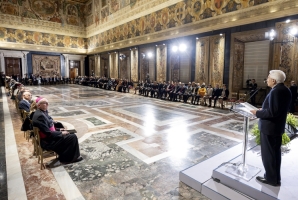
Speech by the President of the Republic, Sergio Mattarella, at the end-of-year celebration to exchange season’s greetings with the Diplomatic Corps
Most Excellent Dean,
Messieurs Undersecretaries,
Mister President of the Parliamentary Commission,
Mesdames and Messieurs the Ambassadors,
Let me thank the Dean, Monsignor Petar Rajič for his considerations and for the greetings he addressed to the Italian Republic and to me personally on behalf of the Diplomatic Corps accredited to the Quirinale, which I thankfully reciprocate.
It is for me a great pleasure to meet you again at the Quirinale Palace for the end-of-year greetings: a moment in which, in addition to exchanging the season’s greetings for the upcoming festivities, we traditionally take stock of the events of the year that is coming to a close.
Regardless of the wishes for greater cooperation and solidarity with which we started off, the year that is now ending has seen the number of crises grow at global level.
A recent survey recorded up to 56 ongoing conflicts – the highest number since the time of World War II – in a context of generally deteriorated conditions of security.
The fronts of war quickly multiply, and the international community is incapable of mitigating them.
It is not a question of objective powerlessness.
As often happens, it is the outcome of more or less informed decisions.
The world is experiencing a grave moment of crisis, and I would like to express the solidarity of the Italian Republic to allthe people stricken with war and conflict.
The exact list of areas of crisis and the rational attempts to analyse the reasons that led up to this situation cannot quash a question.
In what way do we want to be present, as States, in the international community? From the answer of this simple question stems the attitude with which we want to approach our neighbours, our partners, the friendly Nations and the ones that we see as competitors.
Does the solution lie in a show of force at our borders? Will the lives of our people improve with a war? Are we convinced that our relationships with other Countries can be measured according to our capacity to take their resources andtheir hopes of growth, under the pretext of conveying them to our own fellow-citizens? In this third millennium, can the principle of invading other Countries, manipulating their sovereignty and changing the truth, still apply? To what end? For what purported benefits?
What is the role of the international community, afterhaving structured itself in the course of time, if it is incapable of recognizing unfolding crises? If, instead of tackling the problems – by expressing the values that spurred it to unite – it reacts by avoiding them, assuming inadequate attitudes – if not refusing to collaborate, at least of non-involvement with the destiny of peoples?
International humanitarian law does not contemplate putting situations on hold or freezing them.
Also from this point of view, our thoughts wander to the drama of Ukraine, which has now exceeded one thousand days of conflict.
Italy’s firm and resolute support of Kyiv aims for an equitable peace grounded on the principles and values of the United Nations Charter.
This is the goal that underlies Italy’s commitment to host in Rome the third edition of the Ukraine Recovery Conference in July of next year.
Our thoughts wander to the Middle East, where the inhuman terrorist attacks perpetrated by Hamas on the 7th of October of last year provoked a deep trauma among the Israeli people and triggered a spiral of outrageous violence and an unprecedented humanitarian crisis in Gaza, subsequently extending the conflict to Lebanon and setting the whole area on fire.
Together with our partners, we primarily continue to work for a ceasefire and for a constructive process that, with the contribution of the international community, may lead towards the two-State solution: a solution that is just, necessary, sustainable and in line with international law; the only possible prospect of enduring peace. Indeed, the only and urgent prospect if we want to prevent the hostility and resentment sedimented from provoking growingly serious backlashes of violence.
It is not a commonplace formula; it is not a groundless stance.
It was the United Nations Assembly that established a home for the Jewish people following World War II.
Building a future for the Middle East in which Israel and Palestine coexist in peace and security is a task that, once it is developed by those who are now born and grow amongst the rubble of war, we will be in charge of knowing how to expedite.
In Syria, we are witnessing a new combat scenario with the change of regime. It is essential to quickly give life to a new statehood and resume dialogue in these troubled phases, protecting the population and defending minorities.
It is essential – and this is the goal of the Mattei Plan launched by the Italian Government – to focus our attention on the African continent, with its many hotbeds of crisis: Sudan, stricken by truceless warfare; the Sahel region; the Horn of Africa and several regions in Central Africa with their unsolved tensions.
All these conditions fuel the drama of migration in the attempt of so many men and women to save their lives. These dramatic causes of migration are then compounded to those stemming from the climate crisis.
War is not only an intolerable ahistorical anachronism: it represents the denial of humanity. It is peace that we must promote and foster.
The end of the Cold War – that we commemorated this year with the 35th anniversary of the fall of the Berlin wall whichwas its tangible symbol – led us to believe that the time of great conflicting positions was over.
By contrast, the historic overcoming of that condition – whose memory raises no feeling of nostalgia – was followed by the re-emergence of muted contradictions, pages that were thought to belong to the past.
Going back to the time of fragmentation, of national expansionist ambitions, will never represent progress.
Today, reference is increasingly made to “multialignment”, or variable geometry alliances in a multipolar context.
These expressions can appear to be catchy but they lay bare the absence of strategic vision, the absence of a common interest, where only the interests of single Countries find leeway.
Instead of – together – calling for a more equitable world order, better fitted to the new conditions of the world and to consolidating its principles of equality – intended as equal dignity and equal development opportunities – the peaceful coexistence of States is being put to the test.
It is a short-sighted attitude, especially if we consider that the increasingly global challenges of the contemporary world can be tackled – with some hope of success – only in concerted agreement, through collaboration and dialogue, pooling together individual resources.
Exacerbating tensions between States cannot distract us from focusing on our common home, the Earth, and its state of health.
According to recent data from the World Meteorological Organization, the 2015-2024 period was the hottest decade recorded up to now, causing the melting of glaciers, the rising of water levels and extreme meteorological phenomena that increasingly dramatically hit communities and economies, as was recently the case with the tragic floodings of Valencia.
Those who pay the price are especially the most vulnerable, as was recalled by the United Nations Secretary General at the COP 29 in Baku. For some Countries – especially island countries – even the slightest rise in the level of the ocean entails an existential risk.
It is necessary to quickly make a joint effort to hastily bridge the gap between the set decarbonization targets and their actual feasibility. We need to add the necessary momentum to the global energy transition.
International cooperation has one of its strengths in economic relations. The pretence of self-sufficiency is in contrast with the reality of things. Here again, there is a tendency to write off the world’s last three centuries of development on the ground of issues such as national security,thus justifying new forms of protectionism.
Distortive policies and barriers to free trade significantly alter the conditions to access markets and harm the interests of consumers.
History teaches us that protectionism has never brought long-term advantages and, at times, as is widely known, it has even been the cause of armed conflict while free trade – and this is the experience recorded in the European Union – is a formidable growth factor. This growth factor is now also being jeopardized by conflicts, acts of harassment along major trade routes, thus undermining the freedom of navigation, a key element in the freedom of people and the prosperity of all.
Overcoming fragmentation and relying on productive international dialogue between different groups of stakeholder Countries are in and of themselves conduits of peace. And all the more so if they are capable of merging together the future of entire continents – as is the case with the recent agreement between the European Union and Mercosur – whose aim is to protect “common goods” such as biodiversity, food security, and the comprehensive state of health of our planet.
Globalization has also embraced the sphere of human rights and the systems put in place to defend them.
Nonetheless, we are witnessing a phase of a dangerous regression in the condition of women in many parts of the world, along with the worrying and painful growth in the number of children deprived of their most fundamental rights and ultimately of their childhood, if not of their lives.
The lack of respect for human life also underlies the increase in the number of capital punishments at global level, an issue on which Italy shall firmly continue to promote a moratorium, in the hope of abolishing the death penalty everywhere in the world.
Human rights are at the basis of peacekeeping, security and social cohesion. They substantiate Rule of Law principles, especially those involving accountability and equality before the law.
The development of Artificial Intelligence raises new challenges also in this respect. In order to have an objective vision of the world, it is necessary to know that it is not self-fulfilling, and it is not neutral. It is necessary for its development to be inclusive and beneficial to all people. Discoveries and developments in this field cannot be under a private monopoly.
Their governance cannot be entrusted only to the market or to the power of a few. Institutions must be able to turn them into a “common good”, funnelling their potential in a way that is consistent with plans for a collective future of relationships.
Once again, the world is faced with deciding between settlement solutions – that are temporary because they depend on the balance of power at a given time – and solutions issuing from dialogue in the pursuit of common rules.
Of course, what is at issue here is not change or the call for change launched by Countries that quite rightfully request a more incisive role on the international scene.
Rather, it has to do with being capable of building an international order that is not the mere outcome of conflicts –outlining their consequences – but the fruit of a far-sighted effort made while at peace.
Today’s multipolarism spurs us to redesign the architecture and the working methods of international organizations, with the aim of making them fully effective and coherent.
It is a challenge that the Pact for the Future has attempted to in some way meet, not without difficulties.
In this context, Italy feels the need to reaffirm its firm and resolute support of multilateralism, which is enshrined in its Constitution, as I had the opportunity to underscore at the United Nations in New York last May.
It is an issue of great importance, all the more at a time echoing a strongly simplistic and divisive rhetoric.
It is a responsibility that, among others, also the leaders that have won the many electoral processes held this past year, are called to shoulder. A year which has recorded approximately 60 general elections.
It is a task that also involves the new European Institutions, which have been installed following the election of the Parliament.
Europe is, first and foremost, a project of peace.
The pursuit of peace has characterized its genesis and development. The European Union does not represent a threat to anyone. It is a custom that is not among its founding values; it is a custom that it has never put into practice.
It is a condition that does not dicharge it of the need to reinforce a common strategic culture. In this respect, allow me to reaffirm that a full-fledged European defence system no longer appears to be postponable.
Before us is the example of NATO, a defensive alliance called to guarantee the security of the people of allied Countries by warding off the spectre of war.
Italy shall not stop offering its contribution for peace and stability in Europe and in the world and the main goal of the Italian Presidency of the G7 this past year was precisely aimed at a rule-based international defence system.
Most Excellent Dean,
Dignitaries,
Mesdames and Messieurs the Ambassadors,
At a time in which the complexity of the future horizon seems to make disorientation prevail, it is more than ever necessary to re-establish a sound vision based on the value of individuals, of liberty and of democracy.
There are no easy times for diplomacy, a valuable network capable of grasping the sense of worldly events.
The Vienna Convention reminds us that the aim of diplomatic relations is to promote friendly relationships and develop economic, cultural and scientific relations.
Let me add that diplomacy is now more than ever called upon to undertake a towering task: to ward off war; defeat war.
So, allow me to thank you for the work that you untiringly perform to strengthen the ties between your Countries and the Italian Republic and to renew my warmest season’s greetings for Christmas and the New Year to all of you, your families and the people that you here represent.
Quirinale Palace, 13/12/2024 (II mandato)
Altri elementi