percorso pagina
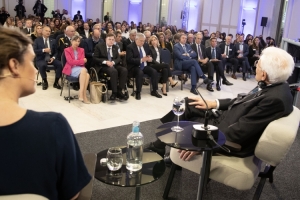
Speech by the President of the Republic Sergio Mattarella on the future of Europe to mark the 30th anniversary of the Maastricht Treaty
Courtesy translation
Mister Governor of the Province of Limburg,
Thank you very much for your kind words of welcome.
Madam Mayoress of the City of Maastricht,
Madam President of Maastricht University,
Dear students,
In 1935 Johan Huizinga published the book titled “In the Shadows of Tomorrow”, which was published in Italy two years later under the title “La crisi della civiltà” (“The Crisis of Civilization”) in the translation by Professor Luigi Einaudi, who would later become the first President of the Republic elected by the Italian Parliament in 1948.
The book’s first couple of pages contain some phrases that appear to be the prophetic image of the extraordinary vision and of the immense merit of the promoters of the European integration process, which was yearned for and designed as the tragedy of the world war unfolded.
This was the European integration that Huizinga – who was arrested by the Nazis in 1942 and died during his confinement in a little village in February 1945 – would never behold.
In 1935, he wrote: “It would not come as a surprise to anyone if tomorrow the madness gave way to a frenzy which would leave our poor Europe in a state of distracted stupor.” However, shortly after, he added: “Never before has man been so willing to do, dare, and continuously sacrifice his courage, his own existence, for a common good. He has not lost hope.”
Two years later, in the introduction to the Italian edition, he added: “I don’t call optimist a man who takes serious dangers lightly but rather one who keeps hopes high even when no way out seems to appear. Hope can only be founded on the improbable.”
The improbable – the possibility that, once the fratricidal war was over, the people of Europe would unite and decide to put their futures together – actually came about.
So, I am happy to be here today, in this border and liaison city, together with the Italian Deputy Prime Minister and Minister of Foreign Affairs, to celebrate the 30th anniversary of a fundamental step – that of the Maastricht Treaty – that has represented a courageous quantum leap in the construction of Europe as, let me recall just one among all the other elements, it introduced the notion of “European citizenship”.
I am honoured to say this here, in this hall, in which the delegations of the twelve Member States of the then European Economic Community negotiated and signed the Treaty that constituted the founding deed of the Union.
The European integration process has been scattered with difficulties and contradictions, requiring obstinate passion and tireless efforts spent in the attempt to understand and harmonize the expectations of the different actors involved.
Of course, the international scenario, starting with the “cold war” and its evolution, contributed to forge the succession of attitudes and priorities of the parties at play.
Since the beginning, this bumpy process has been the fruit of pestering clashes and the coming together of the far-seeing sensitivities of the delegations of the different governments involved in the negotiations.
Allow me to express my satisfaction at seeing that, since the very first steps, the Netherlands and Italy have stood side by side in this exercise.
In the aftermath of the world war, the aspiration of a united Europe arose from the big decision to radically change the course of history in the relations between the people of the Continent. It was grounded on establishing a strong relationship between the democracies that had won back their freedoms with the support of the United States of America and the contributing rationale of Winston Churchill, a global leader who had led his Country to fight back Hitler’s surge.
Two issues, defending the independence and liberty of all and the issue of reconstruction characterized the first steps in the understanding between European Countries after the war.
It could hardly have been otherwise. In recalling this aspect, I almost seem to be outlining the terms of the challenges that loom over the international community today, consequently to the dramatic situation which Ukraine is wading through today after suffering the deplorable aggression from the Russian Federation.
Precisely because it is based on the principle of the people’s direct participation in the decision-making process, the Countries’ different orientations have not been guided by an unchanging univocal line across the past seventy years. Rather, it has been alternatively influenced by the orientations set forth following every State’s electoral processes.
This explains the swing of the pendulum that has accompanied the European construction, the stop-and-go process, the unstable balance between a federalist drive and an intergovernmental option, the unsolved issue of the interdependence between States.
What we find, on different occasions, is the same players line up on one or the other of the possible fronts.
Understanding each other and growing more mutually confident between partners has represented a patient and effective effort.
At the beginning, we saw the gradual consolidation of forms of association such as the 1947 Alliance and Mutual Assistance Treaty of Dunkirk between France and the United Kingdom, later expanded to the so-called Benelux Countries in the following year and then converted into the Western European Union (WEU), with the inclusion of the Federal Republic of Germany and of the Italian Republic following France’s refusal of the proposed project for a European Defence Community.
Here, we recorded a first lesson that was bound to enrich the substance of the European acquis and to constitute one of the founding reasons for the integration process: to put in place defence-oriented institutions aimed at discouraging future wars.
We could say that silent experiences such as that of the WEU – which was soon to be superseded by the North Atlantic Alliance in terms of cooperation on defence – showed their actual importance and relevance if we think that the so-called Petersberg tasks (peacekeeping and crisis management), now stably incorporated into the Treaties of the Union, were enacted in that context in 1992.
I hinted at the theme of reconstruction as a second pillar, which then intersected with the strong thrust coming from the United States of America towards the need for a unitary interlocutor in Europe in view of the implementation of the Marshall Plan.
The establishment of the Organisation for European Economic Co-operation (OEEC) in 1948, although aimed at the management of US aid, represented a formidable opportunity for the governments of Western European Countries involved in the operation to meet and dialogue.
It paved the way for intra-European free trade which, in turn, led to the establishment of organisations such as the European Payments Union (EPU) in 1950, the Continent’s first experimental monetary cooperation effort that provided for the convertibility of the currencies of the 17 member States.
It was precisely the reconstruction of Europe after the devastation of the war that ushered in the experience of the European Coal and Steel Community.
Putting together two strategic resources like energy (coal) and steel (a basic material for weapons and for industrial development alike) must not have been an easy task in an atmosphere weighed down by post-war diffidence.
But thanks to their courage, the six founding Countries, including the Netherlands and Italy, succeeded!
Let’s analyse this success.
In 1951, the governments decided to share the power of jointly deciding over investments, production, the commodities market, and the salaries of the workers involved, and to entrust it to an autonomous collegiate institution (the High Authority), which superseded national legislation.
Let us now ask ourselves a question.
Seventy years later, are we, modern-day Europeans, capable of showing the same courage and of having, at least, the same spirit?
Are we capable of planning to co-manage today’s strategic energy issue?
In respect of the ECSC and its following developments, at the Messina Conference of 1955, an eminent Dutch citizen, Johan Willem Beyen – Foreign Minister in the early ‘50s – had the opportunity to illustrate a plan to expand the scope of cooperation from coal and steel to all the levels of the economy in order to create a common market. Two years later, the Treaty establishing the European Common Market was signed in Rome.
It was not a time of idealists but of very realistic rulers albeit endowed with a clear and daring vision of the future.
I have already mentioned the stumbling blocks that occasionally slowed down, if not suspended, the integration process.
If the most sensational one was that of the European Defence Community, which, as I already mentioned, was voted down in August 1954 by France’s National Assembly, another sensitive moment was the “empty chair policy” in 1965 that postponed the transition from a unanimous vote to a qualified majority vote on European decisions and established the “vital interest” clause for member Countries.
The next step was the referendum on the European Constitutional Treaty (2005), which was voted down by some Countries and that ushered in the Lisbon Treaty, whose design turned out to be inadequate in terms of the nature and the scope of the crises that emerged and of the goal of turning Europe into a key player on the global scene.
After all, there is no reason to be surprised.
This Europe of ours has gone through periods of stalemate – as in the ‘70s – alternatively to periods of intense activity – such as the period that elapsed between the Single European Act and the Maastricht Treaty and the extensive enlargement eastward – and periods of great disappointment, as the aforesaid failure to ratify the Constitutional Treaty.
Nonetheless, we were also accompanied by moments of great hope, as on the first day the Euro was circulated, the progressive success of that extraordinary space of liberty called "Schengen" and the continuous growth of the Erasmus Programme, as well as the capacity put into play in combating the pandemic and its consequences.
We saw the notion of European citizenship gradually taking root.
We, the citizens of Europe, have not arisen out of nowhere.
We have been the hard-working builders of this community of ours since immediately after World War II.
And if today we can look at the horizons of European citizenship, the European single currency, a common foreign and security policy, cooperating in the field of justice and internal affairs, we can do so because we are in debt with Maastricht and the Treaty that made it possible to transform the community-building process into a political Union, capable of stretching beyond merely economic and commercial integration.
It is a milestone and the birth certificate of what a sincere Europeanist from my Country, President David Sassoli, used to call “a new project of hope” based on the aspiration of an “ever-closer union”, as defined in the Treaties.
Once again, the international scenario is crucial and poses deep-reaching questions.
We cannot help but ask ourselves what prospects we imagine for our Union, for the people of Europe.
We cannot dodge our appointments with history.
It is our duty to ask ourselves if we have measured up to the tests that the European Union has come across along the way.
Where and when did we go wrong?
Have we been unforthcoming, too uncommitted?
Have we been too undaring?
Are we running the risk of backtracking, of downsizing our ambitions well beyond what is naturally caused by the growth of other areas?
And again, what do we Europeans want to do with ourselves?
What goals are set by the civilization that we proudly uphold and bear witness to?
Just like thirty years ago, we are requested to make a quantum leap.
Today, we need courageous and forward-looking decisions. Forgoing them would mean shirking our responsibilities, surrendering to irrelevance.
We need to take these decisions and single out the right tools.
The coming into force of the Maastricht Treaty was undoubtedly one of the most stimulating moments in our recent history.
However, we must not omit recalling how, already at the time, a latent Euroscepticism first emerged in the public debate in some of the member Countries questioning the validity of the integration process undertaken.
At the time, the United Kingdom decided to stay out of the Monetary Union and to opt out of signing the Social Policy Agreement; the winning “no” vote on the Danish referendum led to a new negotiation and to setting forth exceptions also for Copenhagen.
But the Union trudged on along the path already plotted.
This happened a while ago.
The context in which we move today has changed.
However, the debates that accompanied the Maastricht Treaty and current debates are historically linked.
The drive towards a Europe of States or a Europe of Citizens has always been the key to interpret the complex European process.
The goal achieved up to now is a hybrid that puts together elements of an intergovernmental system and elements of supranationalism.
Suffice it to think of the direct relationship that European citizens have through the election of the European Parliament, the right of taking legislative initiative that they exercise when calling on the European Commission to put forward proposals for the implementation of Treaties, and through the European legislation that is directly applicable at national level.
After all, it is a founding principle that sovereignty belongs to its citizens.
Intergovernmental cooperation – which has long been considered by many the realm in which it was possible to best guarantee the interests defined as “national” – has often simply been the fruit of the delays of their respective production systems in planning for the future; the fruit of looking backwards, of a static instead of dynamic vision of the growth of civil societies which, in the meantime, have all gone European.
It is a vision that needs to be updated: the nations that make up the Union live in Europe’s multicultural institutional plurality, by which they are acknowledged and promoted.
Of course, as we were taught by Brexit, anything can be dismantled but do we really want to propose to our populations a return to a past that no longer exists?
Especially in an ever more interconnected world characterized by key international players?
Institutions are the product of the epoch in which they operate and they mirror it.
We have succeeded, over the years, in the feat of building an albeit imperfect multi-level democratic system in Europe, in which the citizens are at the same time citizens of a State and citizens of the Union, and they legitimise public institutions through their vote and their participation. The EU Charter of Fundamental Rights, which became binding already in 2009, along with the Lisbon Treaty, stand to solemnly attest it.
Nobody can doubt that there now exists a European interest, of European citizens proper, an interest that transcends, merges, and unifies national interests.
It is a fact and the agenda of facts, prevailing over the political agenda, sets the priorities and the sensitivities.
This is what happened in 1977, when Roy Jenkins, the British-born President of the European Commission, was put in the condition of relaunching the monetary union after the Jamaica Accords had ratified the end of fixed rates the previous year, assuming the dollar as the international monetary standard instead of gold. Thus, the European Monetary System (EMS) kicked off in 1979.
This is what happened when the pandemic threatened many of our Countries, putting people’s lives at risk, altering value chains, and suspending normal production outputs: the European Union, called upon to solve a health issue not directly within its scope of competence, was capable of intervening effectively.
In other words, institutions respond and adjust to the needs that arise and use their knowledge to meet them.
Yet, we cannot be satisfied with the solutions almost accidentally called for by single events, at a time in which peace, and therefore the life of our populations, the future of our youths, are so highly at risk.
We cannot ignore the fact that we often perceive a feeling of distance from institutions among citizens which needs to be remedied as the reasons underlying the construction of Europe that were valid in the post-World War II period continue to be just as topical today.
Dear Political and Academic Authorities,
Dear students,
Nobody can feign surprise on hearing that the European Union is not perfect.
Over the past seventy years, there has continuously been ‘work in progress’, to be kept operational on a daily basis thanks to everybody’s contribution.
The concerns and the impatience relative to the shortcomings of the European construction, instead of producing discomfort and paralysis, must drive improvement and the need to adjust the integration process to the pace of the times.
In the wake of the Conference on the Future of Europe, we are now in a constituent phase, a moment of great participation by Europe’s general public in the construction of the Union to come.
The European Parliament and the European Commission outlined the points that were raised at the Conference.
European citizens expect a more efficient, cohesive, supportive, and representative Union. A fully fledged common house. A Union customized for more effective actions and interactions with the rest of the world.
If everybody showed a sense of responsibility, capacity of vision, and mutual respect and loyalty, we would enhance our sense of belonging in the Union.
Without expecting to be exhaustive, I think that a similar effort could be usefully focused on four fundamental dimensions: upholding common values; assuring the Continent’s security and stability; rethinking the energy policy; completing the EU accession processes.
First, make an in-depth analysis of our sharing of the values and principles that inspire us, which are centred and hinged on a coherent legal system grounded on the Rule of Law. Together, we form a community of law, supported by the principle of the primacy of the legislation jointly passed in Europe over national legislation, in a structured and continuous dialogue between the Court of Justice and the courts of the Member States to assure a uniform legal protection of citizens and businesses spanning from Athens to Dublin, and from Helsinki to Lisbon.
Second, we must continue to make a rigorous reflection on the tools available to us to assure the security and stability of our Continent.
In other words, this means identifying common foreign and security policy objectives capable of giving concreteness to the prospect of the European Union’s strategic autonomy.
It is regretful to think that the Helsinki European Council in December 1999 had already decided to equip itself with an army corps (with 50-60,000 troops) as the tool made available to manage crises in support of a common foreign and security policy.
Strategic autonomy is the necessary basis for the common sovereignty that I mentioned earlier and that represents the stronghold of our freedoms and values: peace, democracy, and solidarity. All the more so today, in the face of the serious security crisis that Europe is going through.
Crucial for the stability and the prosperity of the European Union is also the stability and prosperity of our southern neighbours. The interdependence between the two shores of the Mediterranean requires urgent investments in terms of concentrating our political focus on the Southern Shore.
Indeed, our response to the challenge of migration will only succeed if it is supported by criteria of solidarity within the Union and of cohesion in our external response, as well as a forward-looking policy on the African region.
Apart from the ethical aspects, I think it is worthwhile keeping in mind that in only a few decades, the ratio between the population of Africa and that of the European Union will be of four to one and that the Countries in said Continent, which are rich in large amounts of extremely valuable raw materials, once they develop an adequate organizational capacity, they will wield great weight and influence within the international community.
It is not far-fetched to think that their attitude towards the Union will correspond to the degree of solidarity now shown to them and their migrants.
While the dialogue with the Third Countries of origin and transit of migrants intensifies, we must work to have the principles of shared coordination and responsibility of Member Countries guide our common response to a phenomenon that is decisive for our own prospects of growth.
All this urges the whole international community even further and, as far as we are particularly concerned, also the Union, in the achievement of effective agreements that are respectful of everybody’s rights. This is the roadmap to planning a common future.
Third, we need to reconsider our energy policy decisions.
It would be useless to make a detailed list of the fragilities of Europe that have abundantly emerged in these last months of war, with extremely serious economic and social consequences for our populations.
It is not the time for hesitation or egoistical decisions. On the contrary, the needs to be met are such that they require courage and determination. The progress made in the last few weeks goes in the right direction, starting with the decision to set a cap to the price of gas, something that has already contributed to making energy prices drop.
At the same time, rethinking the Union’s energy policy means stimulating the search for new energy sources and supplies in line with our values, our interests, and with the decisions taken as part of the Green Deal policy, as well as with our foreign policy objectives.
The Union has been a formidable platform to spread around stability and values, putting in play the principle of not having enemies on its borders.
If we hadn’t done this, if we hadn’t assured the continuity and credibility of our cooperation policy, if we hadn’t succeeded to complete the Union’s enlargement process – from Ukraine to the Western Balkans, to which we promised accession to the EU as early as 2003 – we would have left a vacuum bound to be filled by other players that express values and interests different from ours.
It is a “geo-strategic investment” the advantages of which are infinitely greater than the big disadvantages produced by a Union that is self-enclosed, incapable of contributing and defining global objectives and of finalizing agreements with its neighbours.
Dear Political and Academic Authorities,
Dear students,
I have the pleasure of addressing you at the close of a State visit that has renewed and once again sealed the friendship between our two Countries.
This friendship is not manneristic as it enables a forthright debate also on issues in which our starting positions appear to be distant.
The Netherlands and Italy, founding Countries of the Union, share a vision of a Europe that is open to the world, promotes solid values and is attentive to social rights.
The strength of our Europe lies in its capacity to unite differences, find tangible solutions through the coming together of positions that appear to be irreconcilable.
This is why, in gratefully accepting the much-appreciated invitation extended to me by Their Majesties the King and Queen of the Netherlands, it was my wish to close my State visit here and in nearby Heerlen.
Maastricht is a success story and testifies to the fact that negotiation and commitment are not “watered down” exercises but rather processes capable of reaching creative and innovative solutions to the benefit of all the actors who pledge, with honest determination, to support their own vision and to heed those put forward by others.
In the course of the last few years, in the face of an existential crisis of the Union, European leaders have proven to be up to the task.
I have no doubt that also in the years to come our two Countries, together with the other EU Members and Candidate Countries, will know how to offer Europe lofty and ambitious prospects, drawing inspiration from the atmosphere that here enlivened the debate that led to the Treaty.
Thank you and I wish you all a fruitful day!
Maastricht, 11/11/2022 (II mandato)