
percorso pagina
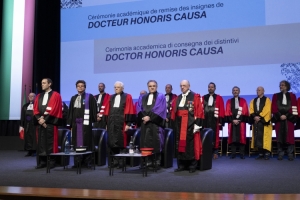
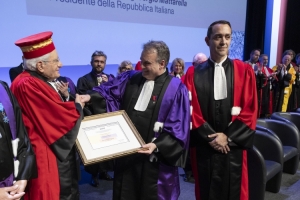
Speech by the President of the Republic, Sergio Mattarella, at the University Aix-Marseille: «L'ordre international entre règles, coopération, compétition et nouveaux expansionnismes».
Monsieur le Président de l'Université,
Monsieur le Recteur de l’Académie,
Monsieur le Doyen de la Faculté de Droit et Science Politique,
Monsieur le Directeur de l’Institut Portalis,
Mesdames et Messieurs les Doyens et Professeurs,
Chères étudiantes et chers étudiants,
recevoir le Doctorat Honoris Causa de cette prestigieuse Université, institution académique majeure en France, est pour moi un réel privilège.
Je tiens à remercier le Président, Professeur Eric Berton, le Professeur Jean-Baptiste Perrier, Doyen de la Faculté de Droit et de Science Politique, ainsi que l'ensemble du corps académique et du personnel. Je tiens également à vous exprimer ma gratitude pour votre engagement quotidien en faveur de la diffusion du savoir.
La France et l’Italie entretiennent une relation de proximité géographique, culturelle et civile qui constitue un atout précieux sur lequel les États amis peuvent compter dans le paysage géopolitique, notamment à l'heure actuelle. Le Traité du Quirinal en a récemment apporté la confirmation.
Marseille, à son tour, en incarne la pleine expression : elle est l'emblème et la stratification de cette civilisation méditerranéenne qui nous unit. Une Méditerranée qui a toujours rassemblé les peuples depuis l'Antiquité et qui, aujourd'hui, n'est pas dénuée d'aspects critiques.
Je salue la Cop4 Etudiante qui, dans les jours à venir, se consacrera précisément au thème de la crise en Méditerranée, ce qui témoigne de la sensibilité des jeunes générations.
L'amitié, la proximité, c'est aussi la responsabilité et l'engagement communs pour relever des défis dont l'ampleur suscite l'inquiétude.
Une Université de cette envergure, où l'on étudie l'histoire et le droit afin de disposer d'outils permettant de comprendre et de gouverner le présent et l'avenir, est le lieu approprié pour s'interroger sur la situation des relations internationales et sur l'état dans lequel se trouve l'ordre que nos Pays ont contribué à définir.
Permettez-moi, maintenant, de continuer en italien.
An international order that, as all social covenants and political structures, can reassert its function and confirm its stability if supported with commitment, honing listening and adaptation skills, as well as cooperation when dealing with the phenomena that show up.
History, particularly that of the 20th century, has taught us that such order is a dynamic entity, subject to balances that are obviously by no means immune from the influence of political tension and economic change.
The roots of these emerging imbalances are often very deep, dating back to the aftermath of past conflicts. Sometimes they correspond to impulses, to ambitions of stakeholders that reckon they can play a new game under new and more favourable conditions as the doubts caused by the possible reactions of the international community lessen and the disappointment with crisis-management cooperation mechanisms grows. Mechanisms that were initially thought up to address rash impulses that aim to reopen situations previously settled at the diplomatic level.
Then again, the generous effort of the institutions set up in the decades that followed World War II, marked by several abrupt halts and frustrations, unfortunately never got to express its full effectiveness.
A number of vetoes in the Security Council have repeatedly prevented the UN from deploying its peacekeeping measures. Nevertheless, what it has managed to do has represented great progress.
Critics of the Organisation are forgetting, however, the crucial role it played in the decolonisation process, or in the drafting of a regulatory framework that aimed to curb military escalation and facilitate disarmament.
A reflection on the future of the international order must go hand in hand with an analytical exercise that, taking due account of the geopolitical uncertainties that characterise our world today, calls to mind the series of events, of actions or inactions, that led to the tragedy of World War II.
History is not destined to repeat itself slavishly. We will never stop learning from the mistakes men committed throughout history.
The world economic crisis of 1929 shook the very foundations of the global economy and fuelled a spiral of protectionism and unilateral measures as alliances grew weaker. Free trade has always been an element of understanding and encounter. Many states failed to realise that the crisis was to be addressed cohesively, rather than settling for 19th century views, focusing on the domestic dimension, at most relying on the resources of subjugated peoples overseas.
Authoritarian drifts gained the upper hand in some countries, attracted by the illusion that despotic and illiberal regimes were more effective in protecting national interests.
A rising sensation of conflict, rather than cooperation, ensued, despite knowing that problems had to be addressed and solved on a broader scale. But the criterion of domination prevailed over cooperation. And wars of conquest followed.
That was the Third Reich’s project in Europe.
Russia’s current aggression against Ukraine is of this very nature.
Today we are also witnessing a return to protectionism. A few days ago, in Davos, the President of the European Commission reminded us that the value of global trade barriers has trebled in 2024 alone.
The economic crisis, protectionism, mistrust among global players and the wrenching of freely agreed rules, dealt the final blow to the League of Nations, instituted after World War I but immediately compromised by the non-membership of the United States which, under President Wilson, had been one of its inspirers.
On that occasion, the US was tempted by isolationism, and eventually yielded. But the League of Nations’ work was not useless, considering that we owe it, for example, the Convention to Suppress the Slave Trade and Slavery, signed in 1926.
In the fragile context of the years running between the two world wars, which witnessed the grim rise of nationalism, an alarming tendency to rearm, the clash between states – according to the reasoning of the spheres of influence – some 20 countries withdrew from the League of Nations.
Germany, with Hitler as Chancellor, withdrew in 1933. So did Japan. Italy left in 1937. The latter two countries (along with France and the British Empire and Germany itself), were permanent members of the Council of the League of Nations.
Unfortunately, from the very onset, the League of Nations was unable to stem expansionism and the repeated violations of territorial sovereignty – in Europe and in other continents.
Thus, in the 1930s we witnessed a gradual collapse of the international order, which undermined the pillars of peaceful coexistence, starting with the sovereignty of each nation within its recognised borders.
The appeasement policies adopted by the European powers versus the advocates of those trends were a vain attempt to curb such destructive ambitions: a clear example was the Munich Agreement of 1938, which granted Nazi Germany the annexation of the Sudetenland, a territory of Czechoslovakia.
Failing to take responsibility led those countries to sacrifice the principles of justice and legitimacy for the sake of avoiding conflict and come to just any solution and to a stability that would inevitably crumble.
The strategy of appeasement did not work in 1938. It is very likely that firmness would have prevented the war.
Fast forwarding to the current conflicts… can it work today?
When thinking about a possible peace in Ukraine we must always be aware of this.
Dear students,
we are delighted to see that today you are participating, you are active, you have many plans.
Your current destiny, the conditions in which we live in Europe, are the result of the choices made after World War II, bearing in mind the millions of people who died in the wars of the 20th century.
Cooperation, not competition. Fraternity where regimes and governments had decided to sow the seeds of hatred.
I am thinking of the hundreds of thousands of young people that World War II snatched from university classrooms and from their families.
The refusal to give in to the violence of arrogance and the sacrifice of those generations have underpinned the longest period of peace that Europe has ever enjoyed.
Seventy years of peace.
Looking at the history of France, one studies the so-called Hundred Years’ War (116 to be exact) with England. But, considering Europe as a whole, we remember the Eighty Years, the Thirty Years, the Fifteen Years wars: historians propose these divisions into time periods, focusing on conflicts.
Seldom do we dwell on periods of peace.
Instead, we ought to call the peace of these decades the Seventy Years’ Peace, so that it may be extended further and that it may never be interrupted. To point out that peace is possible.
That a peace which respects the rights of the individual, of communities and of peoples, is possible.
That it’s not just a conciliatory aspiration not underpinned by facts. Quite the opposite.
At the end of the conflict, the allied powers that stood against the Nazi-Fascist scourge were faced with the need to establish a new world order that would not make the same mistakes of the past and provide new possibilities to an exhausted humanity.
The first result was the San Francisco Charter, which is turning 80 this year.
It is striking and enthralling to read its preamble, which begins – not by chance – with the wording we the peoples. It does not say we the states, or we the nations. It proclaims we the peoples.
Indeed, it reads:
“We the peoples of the United Nations,
determined to save succeeding generations from the scourge of war, which twice in our lifetime has brought untold sorrow to mankind, and
to reaffirm faith in fundamental human rights, in the dignity and worth of the human person, in the equal rights of men and women and of nations large and small, and
to establish conditions under which justice and respect for the obligations arising from treaties and other sources of international law can be maintained, and
to promote social progress and better standards of life in larger freedom,
and for these ends
to practice tolerance and live together in peace with one another as good neighbours, and
to unite our strength to maintain international peace and security, and
to ensure, by the acceptance of principles and the institution of methods, that armed force shall not be used, save in the common interest, and
to employ international machinery for the promotion of the economic and social advancement of all peoples,
have resolved to combine our efforts to accomplish these aims”.
This was the path that was clearly and soundly laid out.
It gave birth to that complex system of international bodies, with the United Nations at its core: the first truly universal organisation in human history, which, albeit amidst ups and downs, has – for eighty years – pursued the primary objective of world peace, the growth and spread of prosperity, and the peaceful settlement of disputes.
And it has done so while always respecting human rights and fundamental freedoms, cornerstones of this new architecture.
The great jurist René Cassin, who was a student and then a professor at this university, co-author of the 1948 Universal Declaration of Human Rights and Nobel Peace Prize laureate, once wrote: “There will be no peace on this planet as long as human rights are violated somewhere in the world”.
The despotism of the fascist and Nazi systems seemed to have been condemned by history.
The system built after 1945 was long supported by the grammar of a bipolarism primarily based on ideological oppositions, which however also corresponded to intentions of power. The Cold War defined international relations for almost half a century, freezing relationships, alignments and the very actors of the international stage. The dominating notion was the terror of a nuclear holocaust.
On 9 November 1989, when the Berlin Wall came down, history and geography in Europe and in the Mediterranean were reunited after the fracture caused by the Cold War. An epoch-making transformation took place and the international order was once again reshaped.
The 20th century ended with the collapse of the Union of Soviet Republics and the rise of a new global order, where the spread of liberal democracies appeared to be preponderant.
Many viewed the end of the Cold War as the fulfilment of Kantian internationalism: a universal peace based on liberal and democratic values seemed to be at hand.
It was the season of the great UN conferences, from the one on Environment, held in Rio de Janeiro in 1992, to the one on Women, held in Beijing in 1995. The Millennium Development Goals were created, the membership of International Organisations was enlarged (China joined the World Trade Organisation in 2001) thus bringing about a gradual integration of stakeholders into the international order.
Humanity seemed to have become aware that it was bound to a common destiny, to a single responsibility.
Globalisation fostered the growth of international trade, reduced distances owing to an increase in ever-more accessible means of intercontinental transport, and ensured a constantly increasing flow of passengers and ideas, thereby broadening the horizons of freedom and prompting many observers to think that it was also the fastest means for achieving peace, cooperation, and possibly democratisation.
Contemporary globalisation has produced unprecedented international integration and growth. Billions of people have been lifted out of poverty. The exchange of knowledge and opportunities has soared exponentially. Scientific progress has made unimaginable progress, enabling practical applications in all areas of human life.
The utopia of a unipolar world burned out in just over two decades. The process has stalled in the face of conflicts of interest, often within the same communities – suffice it to think of the former Yugoslavia in the early 1990s, the instability in many countries of the Horn of Africa and sub-Saharan Africa, the ongoing and unsolved conflict in the Middle East. Actors, often non-state actors – while sometimes supported by states – have set out to conquer, not ruling out acts of terrorism.
Thus, at the beginning of the 21st century, we were gradually confronted with a fluid situation, where risks and a feeling of uncertainty and unpredictability prevailed.
The challenge is to respond in a constructive fashion to the new reality that is emerging.
The traditional international bodies have been joined by the G7, which in turn was joined by the G20. The “BRICS” group membership is growing and represents a rising share of the global population and economic output. It aims to become a pressure group in setting standards and managing opportunities: almost a revised revival of the group of non-aligned countries – which at the time really were so – that was established with the Bandung Conference in Indonesia in 1955.
However, alongside this new multipolar articulation of global balance, the concept of spheres of influence, which clashes with such balance, is vigorously re-emerging. That concept, which my generation fought, underlay the evils of the 20th century.
In addition to this, there are the neo-feudal lords of the Third Millennium – new corsairs to be labelled – whose ambition is to be entrusted with lordship and power in the public sphere, to manage parts of the common goods represented by cyberspace and outer space; almost usurpers of democratic sovereignty.
Let us recall what the Outer Space Treaty states under Article II: “Outer space, including the moon and other celestial bodies, is not subject to national appropriation by claim of sovereignty, by means of use or occupation, or by any other means”.
The modern age was characterised by the Conquest, of land, wealth, and resources. Then, over the centuries, by the gradual abandonment of no longer-fertile territories, and migrations to new shores. And in relatively recent times by the myth of the New Frontier in America.
We do have the rules and instruments to handle this phase, so why does it seem that the multilateral system is failing to do so, risking a repetition of what happened in the 1930s: mistrust in democracy, the re-emergence of unilateralism, and nationalism?
Today, as happened back then, an increasing number of countries deem international organisations superfluous or even detrimental to their own interests and are therefore considering abandoning them.
Whose interests? Interests of citizens? Of the peoples of the world? This does not appear to be the case.
Alas, history tells us that the consequences of such choices have already been written.
Now is the time to take action, remembering history’s lessons and bearing in mind that the international order is not static. It is a dynamic entity which must adapt to change while never giving up the principles, values and rights that peoples have conquered and affirmed.
I have already mentioned Bandung and the San Francisco Charter, and this year also marks the fiftieth anniversary of the conclusion of the Helsinki Conference on Security and Cooperation in Europe, along with the thirtieth anniversary of the OSCE, which grew out of it.
Seventy-five years ago, in October, the Pleven Plan for a European Defence was launched. It followed the Schuman Declaration, presented in May of the same year, which would lead to the institution of the European Coal and Steel Community.
Forty years ago, on Lake Geneva, the US President, Ronald Reagan, and the leader of the USSR, Mikhail Gorbachev, initiated the thaw that led to the signing of the INF Treaty that removed the so-called theatre ballistic missiles from Europe.
In 1990, the CFE Treaty for the reduction of conventional armed forces in Europe was signed in Paris.
This Détente brought about a peace dividend, to be seen in a significant reduction in arms expenditures, and in a season of coming together and sharing.
It was the dawn of a new European and global security architecture.
Once again, dialogue and the spirit of cooperation prevailed.
And what does this mean?
That peace is not history’s gift, which comes for free.
That statesmen and peoples must be committed to peace if they want to achieve it.
That peace must be desired, built and preserved.
Even with the patient deployment of measures that can strengthen trust.
Just think of the vast array of international agreements and treaties that, over the decades, have underpinned it.
What remains of all this?
Step by step, the key players have, at first, begun to violate them and then to condemn them.
So what is the price of security? The threat of resorting to violence, or actually using it?
These are questions that concern, first and foremost, the European Union itself.
Does Europe intend to be just an object in the international dispute, an area where others may exert their influence, or does it wish to become a subject of international politics, for affirming the values of its own civilisation?
Can it accept being caught in the vise of oligarchies and autocracies?
At most, with the prospect of a happy servitude?
We must make a choice: will we be protected or key players?
The Italy of the Communes, in the 12th and 13th centuries, was suggestive, but everyone was entrenched in the defence of their own identity, and this prevented it from becoming a critical mass and surviving autonomously. It was invaded and suffered partitioning.
Europe appears to be at a crossroads, divided, as it is, between smaller states and states that have not yet realised that they, too, are small in the face of the new global scenario.
The European Union is one of the most concrete examples of regional integration and is possibly the most advanced project – and successful example – of peace and democracy in history.
It undoubtedly is a beacon of hope for warding off the return of nationalism-driven conflicts. It is a model of coexistence that, not by chance, has been emulated in other continents, in Africa, Latin America and Asia.
It is a point of reference in international affairs, favouring a dynamic and constructive multilateralism, setting forth values and standards that concretely abandon the specious narrative according to which the ‘bad guys’ method is more concrete and fruitful than that of the so-called ‘do-gooders’.
The European Union sows and disseminates future for humanity. Evidence of this is to be seen in the international stabilisation agreements signed with Canada, Mexico and Mercosur, in neighbourhood policies, in the intentions implemented following the Barcelona Declaration on the Euro-Mediterranean partnership (which turns thirty this year).
International interlocutors must know that Europe is an unwavering benchmark for policies of peace and common growth. A guardian and patron of the rights of the individual, of democracy, of the rule of law.
Anyone who believes these values can be challenged must know that, in the wake of its precursors, Europe shall not betray freedom and democracy.
Are alliances themselves justified solely on the basis of – transient – convergences of interests and are therefore, by definition, variable geometry alliances, or are they also about values?
Europe – as Simone Veil reminded the European Parliament in 1979 – is aware that “islands of freedom are surrounded by regimes in which brute force prevails. Our Europe is one such island”.
Perching on this island is not the answer: we need a stable and mature international order to react to the entropy and disorder generated by power politics, and to face the great transnational challenges of our time.
However, the current institutions alone are not enough and the reflections set forth by the Conference on the Future of Europe in recent years deserve to be taken up and implemented, with a more incisive common foreign and defence policy capable of boosting confidence in Europe’s role when it comes to responding to global challenges.
We have shown that we know how to act effectively in times of crises – for example, during the pandemic – and that we know how to stand against unacceptable violations of peoples’ rights with unity of purpose, as in the case of the Russian aggression against Ukraine.
It is with that very effectiveness and unity we must now renew ourselves, to safeguard the security and wellbeing of the European peoples while contributing to world peace, starting with the Mediterranean region and relations with the neighbouring African continent.
We should not be driven by resignation, but by the will to make the steps required to achieve these results meaningful.
Aldo Moro, the Italian statesman assassinated by the Red Brigades, in his capacity as rotating president of the European Communities (which back then comprised nine countries), speaking at the final session of the Helsinki Conference, proposed to give meaning to the phase of international détente that was being announced, pointing out that it meant “the exaltation of the ideals of freedom and justice, an increasingly more effective safeguarding of human rights, an enrichment of peoples through their better mutual knowledge, of freer contacts, an ever-vaster circulation of ideas and information”.
The European Union – with France and Italy – must be at the helm of a movement that, in claiming the founding principles of our international order, knows how to renew it, paying due attention to the demands of those who feel marginalised by the current architecture.
The path to be followed is not the one that leads astray, abandoning the international bodies. Nor is it that of rejecting the principles and rules that govern us. It is one that calls for a profound and shared reform of the multilateral system, to be more inclusive and egalitarian than the one thought up by the victorious powers of World War II, which, however, deserve great credit for bringing together winners and losers in the creation of a new world.
What we need is new ideas, not the implementation of old models to the new interests of the few.
Universities can help bring forward these ideas.
Dear students,
history is engraved in human behaviour.
The future of the planet depends on the ability to shape the international order so that it may serve the human person.
Choosing multilateralism and solidarity today will determine the quality of your future.
We should not repeat the mistakes of the past, but rather devise a new narrative.
Only together, as a global community, can we hope to build a prosperous future, inspired by fairness and stability.
I wish you – each and every one of you – great success in the studies you are pursuing, in the hope that they will lead you to be mindful and participating actors in the international community.
Marseille, 05/02/2025 (II mandato)
Altri elementi
-
Allocution du Président de la République italienne Sergio Mattarella: «L'ordre international entre règles, coopération, compétition et nouveaux expansionnismes».
-
Intervento del Presidente della Repubblica Sergio Mattarella alla Cerimonia di consegna dell’onorificenza accademica di Dottore honoris causa dall’Università di Aix-Marseille: «L'ordre international entre règles, coopération, compétition et nouveaux expansionnismes».
