percorso pagina
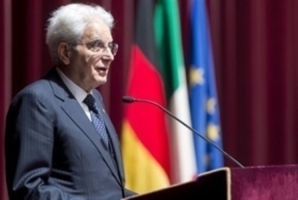
Speech given by the President of the Republic of Italy Sergio Mattarella At the Italian-German High Level Dialogue
Dear President Gauck, thank you for joining us tonight as the second edition of the Italian-German High Level Dialogue draws to a close, and thank you for your words, so full of friendship.
I would also like to thank Mayor Fassino and the city of Turin for hosting this meeting once again.
Warm greetings to the German and Italian Government representatives, the ISPI and DGAP research institute Directors, the speakers, the patrons who have supported this initiative, and all those here present.
The fact that, one and a half years after our first meeting, we are resuming our reflections - or rather, our dialogue - on Italian-German relations, their potential and importance for Europe, is clear proof of the richness of our relationship.
A relationship - rooted in history - characterised after the Second World War by its positive role in the construction of Europe.
The community of free countries that make up the European Union owe much to Germany and Italy's ability to turn the page on totalitarianism and affirm principles of peace and international cooperation.
Italian-German relations therefore go far beyond their bilateral trade and the complexity of their production systems, important as these are in making Germany and Italy inseparable partners.
This applies to industry. There is no aspect of production in one country that does not find complementarity in the other.
It applies to finance and services.
It applies to culture.
This view is supported by the words we have just heard from the working group rapporteurs. They have tackled issues that are not only delicate ones for the whole Continent, but also issues on which the very future of European integration hinges: the digital market, the European Union's foreign policy, security, migration.
Allow me, therefore, to briefly review the three topics of this meeting, on which the rapporteurs have just delivered and summarised the various positions that emerged during discussions.
The solutions that - by working together - we will find in order to regulate the digital market at European level could further strengthen the single market and, as a result, provide new momentum towards continental integration, mirroring the virtuous mechanism that has for years been the basis for the traditional "functional approach" towards European unity.
Here too, it is a case of writing the rules that Europe needs. Rules that must allow us not only to maintain intact the goal of an efficient single market, in an extremely delicate area for our future, but also to give the Union the tools to effectively interact with other great global commercial and economic blocks. Furthermore, as well as such substantial economic interests, supporting digital culture also has another, perhaps even deeper, meaning.
For some time, the digital world has been a key tool for new generations. It deeply permeates their very way of life and how they express themselves. It contributes significantly to shaping this.
Among our most pressing needs is undoubtedly that of consolidating an awareness of the European Union's importance among young people: we must ensure that Europe is able to keep up with the "digital generation", actively accompanying its growth and making our young people active players and not just users and consumers.
If we are up to this task, Europe will be a key player, as we all hope it will be, in a sector that is increasingly fundamental in terms of the economy, employment and research. However, should certain interests and egotism prevent us from developing and implementing brave rules allowing an authentic digital Europe to develop, this would give an extremely negative message in terms of our cohesion and our overall ability to keep abreast of our times and compete in the global economy.
We know, as the conclusions of the other two panels made clear, that a "functional" approach to integration - which has given us so much and can continue to do so - is a necessary component, but no longer sufficient per se to guarantee Europe the cohesion that is so essential in order to tackle this extraordinary historic change.
Migratory pressure, the crises underway on Europe's doorstep, the instability in some regions of Africa and the Middle East, the scourge of terrorism; all these phenomena clearly show the need to do more, and to do so through a truly united approach.
When the first edition of this Dialogue took place in December 2014, the focus of discussions was still mainly how to govern the economy, how to balance budgetary discipline and flexibility, development and employment.
We cannot affirm that we have managed to find a stable solution to something that remains, in many ways, an unresolved issue in the Eurozone, even though some positive choices have been made, such as the approach pursued by the European Central Bank. Now the credibility of the Union's response will be measured by the tangible results of the Juncker Investment Plan and the Commission's Communication on flexibility. And it will be measured by the progress made in the Five Presidents' Report.
In recent years, Europe's political agenda has been dominated by the consequences of the crisis: now this aspect is interwoven with, and must be tackled with, the threat of terrorism and migration, issues perceived as being even more insidious for our countries and our Union.
They are issues which are added to unresolved problems from the past with a "cumulative effect", triggering a widespread lack of confidence in public opinion in the ability of national Governments and the European Union as a whole to handle these crises. From this is born the tendency to close in on oneself that is spreading in our societies, and this often paves the way for various feelings fuelled by collective fears.
It is illusory to think that the solution lies in renouncing what we are. Renouncing the fundamental principles of our being European, the rights we have built and have the duty to protect and spread, for ourselves and future generations.
Simplification does not offer responses equal to the broad scope of the phenomena we are faced with.
These have a global dimension that is in no way transitory and risks crushing naively "isolationist" solutions.
No man is an island, as John Donne already warned back in 1600. ("Every man is a piece of the continent, a part of the main... And therefore never send to know for whom the bell tolls: It tolls for thee").
These words, so lucid and evocative, reveal the impossibility of thinking that a single population can be an island in times of globalisation.
Europe has guaranteed decades of peace and prosperity, it has assured widespread wellbeing and a high level of rights and safeguards for individuals and communities: it is our duty to ensure that the results achieved are not taken for granted and, above all, that they cannot be called into question.
It is our duty to underline the need to act with foresight, balance and respect for the founding values of our Constitutions and the European Union.
This is the context in which Germany and Italy, founding members of the Union, find themselves working in today.
Two countries that, having paid a high price for the tragedy of nationalist exploits, believed more than others in the European horizon.
Countries that inherited a European vision from Adenauer and De Gasperi which we were able to nurture over the years and that today, once again, we are called upon to uphold and keep alive.
I would like to take this opportunity, a few days after his passing, to pay tribute to the European spirit that characterised the life and political career of Hans-Dietrich Genscher, who will remain for us all one of the noble fathers of Europe.
Having a sense of our heritage and of who we are must, today, take the form of a new accountability towards European citizens, first and foremost, but also towards the world that looks to Europe and needs European civilisation.
It is not possible to leave the thousands of men, women and children fleeing the war, violence and devastation knocking at Europe's doors without an answer.
The unprecedented migration issue must be tackled with an intelligent sense of reality: welcoming those who have a right to asylum, integrating those who come to work in our society and in so doing contribute to our wellbeing, firmly combating human traffickers.
Registration, asylum, relocation and repatriation for those who do not have the right to asylum are all one package: there cannot be any effective registration, however complete and scrupulous it may be, without effective relocation and without repatriation agreements with countries of origin that the European Union is best placed to handle.
We must give responses equal to our values when it comes to this moving mass of humanity, often enslaved by base traffickers. Our values will assert their authenticity and authority only if they are able to obtain recognition for the treatment provided to those in difficulty, only if they offer a tangible, effective aid programme to promote peace and development in the migratory countries of origin, knowing that no multitudes of people leave their own country if they can live there peacefully and serenely.
Tangible and effective aid programmes for these countries must be prioritised, both because it is right and in order to stop migration flow at its source, preventing it from becoming increasingly momentous and ungovernable.
Only in this way can we be victorious in this great challenge to civilisation. Germany and Italy feel this responsibility and have shared values underpinning it. It is telling, I believe, that Gianfranco Rosi's symbolic and intense film "Fuocammare" received the prestigious Golden Bear prize in Berlin.
Faced with an understandably confused public opinion, Germany and Italy are called upon to firmly reassert that there is no alternative to the process of progressive integration, building on their deep-rooted European foundations.
We do not have a "plan B". No one can realistically claim to have a "plan B", based on a supposed "national" solution to the problems affecting our Continent. In fact, we could say that the instances in which Europe was shown wanting in its welcome of refugees, in its foreign policy, or in effectively combating groups of extremist assassins, was due to a lack of Europe and not an excess. More Europe does not only mean more solidarity, but also more security. This must be emphasised when it comes to the reality of our current predicament. If our shared European fabric is weakened, if the ideal of the Union is eroded, we all become more vulnerable.
Walls and barriers will not be enough to protect us if Europe does not move forward in a united front. We have worked for seventy years to bring down the walls that divided Europe: let us not allow them to re-emerge, creating dangerous tensions and suspicions instead of much-needed cohesion and trust. Barriers dividing Europe would be a ballast weighing down its journey. I am happy to note that yesterday a representative from the European Commission spoke in no uncertain terms on what is occurring at the Brenner Pass.
To go back on Schengen would be self-destructive for us all.
Germany and Italy, while they boast widespread and deep-rooted accord on many issues, clearly also have different opinions on certain specific points of the European and international agenda.
Nevertheless, our countries have never resorted to policies that reject dialogue. On the contrary, the approach has always been constructive, geared towards identifying points of balance and bringing the consensus of other EU member states in line with these, so as to find a shared, never an imposed, stance. This is the working method that Germany and Italy have always proposed at European level. It is more valuable than ever now that the objective complexity of the issues at stake makes it harder to identify sustainable, long-term solutions.
Having said that, the voice of European citizens that has made itself heard over the past few days to call for the barbarism of terrorism to be fought, bears witness to the pressing need for European unity that cannot go unheard, but rather must be met by a coherent, rapid response.
It is necessary to strengthen collaboration among EU member states on matters of security, overcoming any resistance to the need for shared knowledge and capabilities.
The European Union must tackle the deep-rooted causes of instability. It needs to "speak with a single voice", authoritatively, developing a foreign policy in line with its founding values. To live securely means having populations at one's borders who can live and progress in peace.
From Iraq to Syria, from Libya to Sub-Saharan Africa, there comes a need for a Europe able to act responsibly and foster the necessary international convergences so as to combat instability and promote long-lasting solutions to the crises underway.
Today's world is witnessing a process of increasing regionalisation.
Increasingly structured macro-areas are called upon to take on increasing responsibilities in handling global balances, and this will continue into the future.
It is a growing phenomenon that looks with interest - often with admiration - to our own experience and the model of the European Union.
It would be paradoxical if we Europeans were to weaken these expectations through our own behaviour. The demand for a united Europe, and the model it represents, comes from us and from outside us.
We can see this, for example, when we look at the Western Balkan countries, that see in Europe the culmination of a process of progressively adapting and moving closer to the standards of our community.
It is a process that the Union must continue to follow with maximum attention and consideration, and that cannot in any circumstances be interrupted.
The demand for Europe also comes from nearby Continents, as I personally observed during my recent trip to Ethiopia and Cameroon, as well as my visit to the African Union. These countries are of central importance when it comes to maintaining the balance in the Horn of Africa and the Gulf of Guinea.
Responding to this demand for Europe does not only fall to institutions and politics. It is important, but it does not only fall to governments.
Following in the footsteps of President Gauck, I too would like to outline a mission before the German and Italian representatives of economic and social life here present: we need "Mehr Europa" - More Europe.
This is our great shared responsibility.
On this note, I would like to once again thank all those present, particularly and once again President Gauck, for honouring this second edition of the Italian-German High Level Dialogue with his presence, and for his constant, enlightened commitment in the service of Germany and our shared house of Europe.
Turin, 13/04/2016 (I mandato)
Altri elementi