percorso pagina
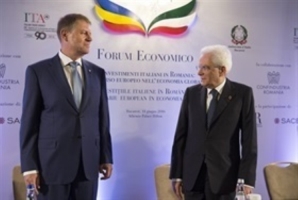
Address by the President of the Italian Republic, Sergio Mattarella, at the Italian-Romanian Economic Forum "Italian investments in Romania: a European Route into the global economy".
Mr President of Romania,
Authorities,
Dear businessmen and women,
I would like to first of all thank President Johannis for the warm words addressed to Italy and to me personally and for the caring hospitality extended to me during my visit to Romania.
I would especially like to thank him for his presence here today as it bears witness to the attention with which Romania - at top Government level - follows the development of bilateral relations between our two Countries.
I would also like to express my appreciation to Ambassador Brasioli who, together with ICE, Confindustria Romania, the Italian Chamber of Commerce for Romania and SACE, organised this forum of debate on economic and commercial cooperation between Romania and Italy.
Allow me to address a warm greeting to all the representatives of Romanian Institutions and Authorities present here today and also to the many Romanian and Italian entrepreneurs who will liven the debate.
However, the meaning of this meeting goes beyond the albeit very relevant economic, commercial and financial domains on which it is focused.
The many, many Italian companies that have settled in Romania over the years, and the stable presence of an exceptionally large Romanian community in Italy - the largest of all the foreign communities - are the fruit of deep-set and well-articulated relations grounded on investment and trade.
The millennial ties that unite our two Nations denote a cross-fertilisation between our societies that is unmatched. Our people have succeeded to find, each one in the territory of the other, the opportunity to develop their lives - personally and professionally - as if they were in their own home Country.
In the last few years we have witnessed a constant and virtuous strengthening of this integration.
I see here today some "pioneering" entrepreneurs who came to Romania either before or immediately after the fall of the Communist regime; while others here contributed to creating the "miracle of Timisoara" which, with time, has become a full-fledged "case study" on the birth and development of a successful industrial district.
Present here are also entrepreneurs and professionals who have only come here during the last few years, riding the wave of a progressive integration between "Brand Italy" and "Brand Romania". This was made possible by the favourable conditions that this Country has always created for Italian corporate investments and activities and, of course, also thanks to your courage and your enterprising spirit.
Yet, curiously enough, there was a long debate on whether this process was to be judged good, being obviously underpinned by a positively robust internationalisation of our companies, or wrong, as if it were to be considered an unambitious industrial delocalisation in the pursuit of the lowest possible wages.
It is significant to note that these last few years' economic crisis only had a relative impact on Italian businesses in Romania, thus proving the existence of a solid groundwork, consolidated by profound relations, on which new opportunities develop in a natural way.
It is the very same groundwork that, based on the same virtuous and positive analogy, has integrated a community of more than one million Romanians, made up of an ever-larger number of lively self-employed entrepreneurs in line with the characteristic Italian tradition of "doing business" in our Country.
This experience suggests that this commitment creates an inevitable and positive path along which the capacity to overcome national barriers constitutes a factor of wealth and development.
We all know how extraordinary the "numbers" in the Romania-Italy relationship are.
You know better than anybody else because you, along with so many Romanian citizens who live and work in Italy, are the ones that make them on a day-to-day basis.
More than 13 billion in trade volumes; more than 20,000 Italian companies operating here in Romania; more than 60,000 small Romanian entrepreneurs working in Italy.
The list could be much longer and it does not only mirror the solidity of this economic, commercial and financial relationship but, above all, it makes us reflect on its dimension in terms of integration, on the extent to which our Countries are profoundly close, almost symbiotic.
It is an extraordinary heritage, in which the political scope of Romania's membership in NATO and in the European Union has only contributed to consolidate the values within the Community, in a decidedly short period of time.
Mister President,
Ladies and Gentlemen,
This positive situation between our two Countries leads us to make some general considerations on Europe and on the process of integration of the people of our Continent.
Indeed, the depth of the relationship between Romania and Italy is primarily based on everything that you have succeeded to create: personal ties, often at family level, which make both Romanian and Italian citizens feel "at home" in either Country.
In essence, we share the same culture.
This situation is the result of the "right of establishment", a core principle of the Union that, between our two Countries, has found one of the most fruitful applications in all of Europe.
It is precisely this interweaving of personal and professional relations, which has successfully become inextricable, that contributes to the emergence of a truly European "demos".
A "demos" in which - in the respect of identities, specificities and traditions - different European peoples have increasingly amalgamated.
This process, continuous and silent, has produced tangibly visible results in terms of the protection of rights, of sensitivities, of ways of life, which constitute the common and indivisible heritage of our Union.
The continent's integration process was begun in order to shorten distances, draw people closer, by guaranteeing that every European, wherever he or she may live, lead his or her life on the basis of rights, duties and protection, which are assured, shared and defended - together - beyond one's own national and EU borders.
Italy and Romania constitute, in this sense, a tangible example of the distance covered by Europe and from which no person of common sense would never imagine stepping back.
The will to remove barriers between people is the basis of the support that Italy has always assured to Bucharest's aspiration to complete the European integration process and to fully participate in the Schengen system.
The second consideration I would like to make concerns the difficulty that Europe is experiencing in this period. On the one hand we have achieved, in our Union, very high peaks of integration. On the other hand, there are increasing signs of discomfort and of not understanding the way Europe works among citizens who have difficulty in remembering the amount and the nature of the real benefits that European unity means for them, benefits already acquired and at times overlooked here but that are always at risk without the Union's progressive and complete consolidation.
We cannot simply explain to the new generations how unnatural a divided Europe once was, how painful were centuries of conflict and especially the two World Wars and how the continent's progressive integration has enabled this Europe of ours to live in peace and growing well-being for the longest period in its history.
It is essential to recall the memory of the past and enrich it with the facts of today, thus enabling Europe to meet present challenges.
In order to make its way back into the heart of Europeans, the present level of integration needs common political Institutions that citizens can easily identify, and capable of providing individual and collective solutions to the real and seriously detrimental problems that European society is faced with in this phase.
In many sectors of activity, the flow of sovereignty from Member States to the Union has not been satisfactorily completed and this is another reason why the Union does not yet appear to be ready to effectively respond to many of our citizens' needs.
We are simply before a crossroads. We can escape reality, turning backwards towards an ahistorical attempt by States to recover sovereignty, thus surrendering the many conquests achieved over the years.
Conversely, we can continue to look to the future, to the natural completion of our Union, which must be based on common Institutions, building on those that already exist and creating new ones, in order to provide our citizens with the answers they deserve in these difficult times.
Europe is unarguably "work in progress", in some way work permanently in progress, but this work needs to be continuously improved.
Italy - and I dare say also Romania - are among the nations that unquestionably intend to make a positive contribution to this "work in progress" that will inevitably be completed, regardless of the legitimately different decisions of other Countries.
You all know what needs to be done, especially in the field of finance.
For example, completing the banking Union, endowing it with a common safeguard mechanism, developing a welfare system against unemployment and going forward with the decision to implement continent-wide infrastructure, are all proposals that go in this direction, that raise the level of protection awarded to single individuals, that reinforce social networking, that consolidate the idea of a Europe that does not abandon its citizens and, on the contrary, increasingly calls on them to take part in the decision-making process.
These are the ideas that Italy has formulated and continues to uphold, because they are fully in line with the staunch Europeanism that has constituted one of constant lines of our Republic's foreign policy over these past 70 years, which we celebrated only a few days ago.
Mister President,
The need for answers is made more urgent by the international economic cycle that we find ourselves in and especially by the pressure of migration flows which are the result of the widespread instability that spans from the easternmost to the southernmost borders of our Union.
Also in this case the Union must provide answers: to this ailing humanity that would do anything for a better future, and to its citizens, who need to see that it is capable of managing an epochal phenomenon destined to last over time.
After an excessively long period characterised by contingent solutions, we are now seeing signs of a strategic, long-term vision. A collective effort has drastically reduced flows from the "Balkan route" and a framework of reference for migration flows from Africa is beginning to be outlined also thanks to the contribution made by Italy's proposed "Migration Compact".
Whatever the policies adopted by the Union at the end of this process might be, it is important to continue to be firm on one point: this phenomenon must be tackled in all its aspects within a coherent framework of reference capable of upholding the rights and values that we have acquired and never forgetting, not even for one minute, that migrants are people whose lives and dignity must be protected at all times.
Removing the causes of great migration flows where they originate and tightening our cooperation with the Countries of origin and transit with a view to fostering their development and to asking them to cooperate in managing the migration phenomenon are crucial points that need to be addressed immediately.
Points on which the Union will have to show it has the capacity to set forth a coherent and univocal security and foreign policy matching up to the values and aspirations that are an integral part of our European history.
Mister President,
Dear friends, Romanian and Italian,
These issues are only apparently remote from the reasons that have brought us here today because Romania and Italy are an example to follow within Europe.
The extraordinary level of integration between our societies is proof of the viability and the concrete practicability of that "quantum leap" that we deem urgent and necessary for our Union to make.
Italian entrepreneurs in Romania and the Romanian community in Italy will, I'm sure, know how to facilitate this transition, acting with courage and responsibility and grasping the many opportunities that, despite the difficulties, emerge in a historic period as complex as the one we are living.
It is with this wish that I thank you once again and take leave of the President of Romania and the participants in this Forum, wishing you a very fruitful day of debate.
Bucharest, 14/06/2016 (I mandato)
Altri elementi