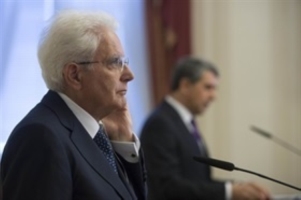
I greatly thank President Plevneliev for his friendly welcome and I agree with everything he has said. In this meeting, we have not only noted the great and sincere friendship that exists between Bulgaria and Italy but also their great accord.
President Plevneliev pointed out several issues that I too would like to underscore: we are bound by the common fate of the European Union, we are bound by the NATO alliance and we have a common vision of what the European Union should achieve and develop at this point in time.
We agree on several points in particular.
First of all, the value system of the Schengen Agreement, one of the souls of the European Union, is a condition that has come to form part of the way of life of our youths and that must be preserved. Italy is staunchly in favour of Bulgaria's full integration into the Schengen system.
We fully share the conviction that now, after the British referendum, is the time to confirm the validity and importance of the enlargement of the European Union to the Countries of the Western Balkans, some of which are already members, while others are candidate countries negotiating their accession. It is our common opinion that these Countries must be made to understand that the enlargement is neither being suspended nor frozen but confirmed. This is the way not only to proceed, at the required speed, along the path of completing the Union, but also of maintaining, in the Western Balkans, the condition of cooperation and of mutual commitment and comprehensive peace that these Countries have the great merit of pursuing.
We agree on the need for a European-wide energy plan. The Union has the interest and need to assure energy supplies to all its member countries and to secure different energy sources, and we look with interest - an interest that is strategic for the Balkans and for the European Union - at the interconnection to be implemented with Greece and Bulgaria.
We also agree on the most sensitive issues, the biggest emergencies of this period: the migration issue, the threat of terrorism and economic and financial security. All of these three fronts require a greatly enhanced common commitment by the European Union. None of them can be effectively tackled by any one Country single-handedly and they require a common, shared and coordinated action on the part of the Union.
As for the economic and financial situation, it is certainly an important priority at this time to guarantee a perspective of security for our youths through economic recovery and the creation of jobs.
We also agree on the struggle against terrorism, which can be effectively carried out through better coordination between the intelligence services and police forces of the EU Countries. In addition to this there is the evident need to tangibly and swiftly relaunch the European Union's common foreign and defence policy project. The European Union cannot be a spectator, as is often the case, in international crises and in the critical scenarios we have before us, standing by while the players in these crises solve the problems.
The Union, with a common foreign and defence policy, can be a major player and make a decisive contribution towards solving the crises whose consequences spill over into the life of Europe.
More specifically, we need more European policies on immigration: such an epochal phenomenon can only be faced through a systemic, coordinated and comprehensive action by the European Union. It can be done through a comprehensive action spanning from border control to relocation or repatriation of migrants and through an investment policy in the Countries originating migration flows because, by improving the conditions there, it is possible to stop, or at least strongly diminish, the causes that spur so many people to emigrate from their own Countries. This is what Italy has proposed in the Migration Compact, which the European Commission has indicated as the guide for an investment plan. It is essential that this plan be implemented and that every EU member State and the Union on the whole take real and concrete responsibility for it.
In short, with President Plevneliev and with the delegations assisting us, we recorded full agreement on all the issues of relevance.
It is not a coincidence that, ever since ancient times, the history of Bulgaria and of Italy has recorded great ties and important connections. Today, our status as EU member Countries, with the same vision of European integration, and as NATO allies, translates this historic link into modernity insofar as, in addition to the cooperation between our institutions, it is assured by the friendship between the Bulgarian and Italian people.
This is why I greatly thank President Plevneliev for his friendly welcome and for the very interesting meeting we just had.
Question: After Brexit there are many points to be clarified. What relations should we have with Great Britain, which is establishing bilateral relations that bypass the European Union and are therefore divisive? How can we avoid the possible contagion, seeing the great diffusion and revival of nationalism in many EU Countries? And how can we avoid an economic fallout on our still struggling economies?
The President: I start from the consideration that the outcome of the British referendum was a surprise and a reason for regret for everybody. Naturally it is a result that must be respected. It is clear that Great Britain remains a Country that is not only an ally but a friend, and this makes it possible, and necessary, to establish clarity in the relations between the United Kingdom and the European Union within the necessary timeframe, but not longer than that. The relationships that will characterise these relations will be requested by a Country that is a friend of the Union and by all the member States of the Union.
The backlash produced by the British referendum has faced the European Union and its members with the need to make a deep reflection on the state of the Union, its accumulated delays, the need to adjust its course of action and the initiatives that need to be taken.
The historic value of the Union and of European integration is out of question; suffice it to think of the consequences, during the last century, of World War I compared to the choice of integration made after World War II. The peace, growth, wellbeing and collaboration process triggered by the reunification of Europe in these last few decades has such historic relevance that it can in no way be questioned. It is necessary that younger generations perceive the importance of this. It is a historic truth.
Therefore the first thing the Union must do now, and not in a few years' time, is to develop tangible policies to guarantee the future perspectives of young Europeans: relaunching the economy, creating more jobs, assuring greater social security.
In addition to this, the Union must also respond to the other emergencies perceived by our fellow-citizens, such as the emergency of terrorism and migration. The Union needs to put in place a more intensely cooperative and integrated policy capable of effectively tackling these issues and emergencies, because no Country can do so on its own. These are the necessities that the EU Council and the European Commission will have to face in their next meetings. We are convinced that the upcoming meetings in Bratislava in a few days' time will reveal great awareness of these questions and of these necessities.
It is a set of reasons that drive us to be increasingly convinced of the growing need for European integration, which is ever-more confirmed by what goes on around us. Now every problem is global and if Europe decides not to just stand by and watch but be a major player, it needs to strengthen its integration.
Question on the problem of immigration.
On this front, Bulgaria and Italy, being Countries of destination for migrants, share the same perception. They are also Countries that are often witness to all the people who die in the attempt to reach Europe's coasts. Besides and beyond political choices, perhaps we should never forget that behind every person who drowns in the Mediterranean or elsewhere there is a person whose plans, dreams and future disappear with him or her. It is an epochal phenomenon which, unless Europe assumes adequate and responsible initiatives, is bound to grow in magnitude.
Unless we adopt a real, organic, serious and responsible project to manage the difference in population growth between many African and Asian countries and Europe, this phenomenon is bound to become unmanageable.
There are two roads that the European Union must now swiftly pursue: the first is the one initiated with the La Valletta Conference, which triggered a debate between the European Union and some of the countries of origin and transit of migration flows, in which the European Union assumed commitments that must be honoured concretely, like giving aid to the Countries originating migration flows because, by improving their economic and living conditions, we can curb and discourage young people from leaving their Country and migrating.
This needs a big investment effort and this is what Italy proposed in the Migration Compact, which the European Union defined in the investment plan that must now be developed, approved and implemented.
In the meantime, it is necessary to also develop other initiatives and activities that can only be effectively performed by the European Union. It has been decided to put in place an EU common coastguard to patrol the external borders of the Union. Of course this implies that the EU must jointly manage every aspect of the phenomenon. It is not sufficient to jointly patrol the Union's external borders; it is necessary to have a common asylum policy, to go beyond the Dublin system, which was developed and agreed many years ago, when the phenomenon had not taken on the current dimensions, and to define a common European regulation for asylum applications, to be managed by the EU as such and not by single Countries, along with a common relocation policy for those entitled to asylum and a common repatriation policy for those who are not entitled to asylum and must be repatriated to their Country, through readmission agreements with their Country of origin.
Therefore: border surveillance, common asylum rules, a common asylum system, relocating those who lose their asylum and repatriating those who are not entitled to asylum through readmission agreements with their Countries of origin. These are all activities that the Union can perform but it must decide to do so concretely and immediately, otherwise no Country will be able to handle the phenomenon on its own, not even those who think they can close their borders, because no border can hold out before a phenomenon that is ever-growing in magnitude. The European Union must immediately choose to pass this common policy. This is yet another issue that the Union will have to face in the coming weeks and months.