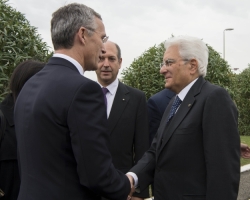
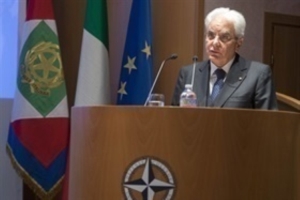
It is with great pleasure that I take the floor, Mr Secretary General, on the anniversary of the NATO Defense College that we are here to celebrate today.
In the course of its 65 years of activity, this College has tangibly contributed to consolidating transatlantic ties, training generations of Officers from Allied Countries and not only from these.
All this would not have been possible without the tireless work of the permanent corps of Commanders who have alternatively taught here.
Allow me to thank Gen. Janusz Bojarski and, with him, all those who have preceded him in this task.
The presence of military and civilian personnel from the Countries that belong to the Euro-Atlantic Partnership Council, to the Mediterranean Dialogue and from other partner countries, has contributed to enriching the subjects taught, in an exchange of experiences and sensitivities which, in our modern globalised world, has become an irrefutable necessity.
The works produced by the enrolees in all these years - in the 50 years that the College has been hosted here in Rome - bear witness to the evolution of NATO's doctrine from the '50s to date, with interesting forecasts of scenarios and perspectives, to the all-round vision it has today.
This is the setting in which arise the new - prevalently hybrid - challenges that impose on the Alliance the need to continuously take stock of the instruments it disposes of. The realm of cybernetics, for example, has now taken on a relevance that can be equated to the traditional importance of sky, land and sea, heightening our awareness that a single State cannot face up to it alone.
Only renewed proof of the unity and of the deep-set solidarity among Allies is capable of defending the values of our democracies.
These values are the groundwork for the freely chosen partnership entered into by the Countries of the Alliance but which now, in the light of our present-day reality, needs to be reinforced, as it pushes us - even more than in the past - to overcome boundaries or mere national perspectives because only together will we all be safer, stronger, freer.
In an increasingly globalised and interconnected world, what happens within and above the States has repercussions on everybody: from terrorism to the enormous challenge posed by epochal mass migrations.
In order to match up to emergencies of this magnitude we need to abandon partial approaches and national reasons and start thinking in even more unitary terms, dialoguing with all the members of the international community who share the same concerns.
The Alliance must adjust to these changes and it is doing so with the same efficiency that has always characterised it.
Suffice it to recall the initiatives of the Partnership for Peace - established to integrate past adversaries into the same process - or the Berlin plus Agreement, a significant step forward in the cooperation with the European Union, or the Mediterranean Dialogue and the Istanbul Cooperation Initiative.
The Warsaw Summit of last July confirmed that the Alliance is aware of the changes that are underway.
The crises that we are witnessing East and South of the Alliance are part of the broader state of precariousness of the international security system.
Italy wittingly and staunchly supports the need to share responsibilities in facing up to them.
This certainly leads to changing the focus of the Alliance's mission which, in the past decades, as the instrument of the international community, has engaged in situations originally defined as "out of area".
Warsaw (as Lisbon before that) confirmed that the 21st century NATO is willing and ready to develop new synergies: from strengthening relations with partner States to those with other supranational and international organisations.
We therefore welcomed with great satisfaction the signing, at the Summit, of the EU-NATO Declaration, as it marks a turning point: never, up to now, had the two Organisations committed, at such a high level, to such a detailed road map. Allow me to congratulate the Secretary General for this achievement.
Italy firmly confides in the potential of this cooperation and in its further development, especially in a phase in which the European Union is undergoing an inevitable adjustment in the aftermath of the British referendum.
London remains - in our view - a crucial partner in the Western world, and an essential ally.
We sincerely hope that the British people will want to continue on the road of cooperation.
Mister Secretary General,
It is on these grounds that Italy lives its membership to the Atlantic family, to which it has never failed to give its contribution in terms of vision, even more than in terms of men and means.
An active and responsible participation based on solidarity among the members.
Indeed, also almost 70 years on, these are the values with which we continue to identify.
These values now bring us to favourably consider the reassurance asked for by our Eastern European Allies but also to assure the continuity of our participation in the missions in Afghanistan and in Kosovo.
Strategically, there is a lively debate on the threats coming from the East. Some have even equated the friction recorded of late to a return to the "Cold War".
But nobody can set back the clock of history.
Nor does it seem reasonable to propose rebuilding a barrier that fatally recalls that iron curtain that, for so long, humiliated the pursuit of freedom of entire populations and that, for it to be brought down, it needed that the Atlantic world show its determination, in addition to the lengthy process that began with the Helsinki Conference.
It is essential to put an end to the irrationality of a moment of tension, the danger of which is experienced by our military on a daily basis.
Shows of force, continuously putting our power to the test, triggers an escalation that takes years of mutual confidence-building to reverse.
Of course, it is essential to give priority to re-establishing the international rule of law.
Dialogue remains crucial.
Having convened the NATO-Russia Council has represented a step in the right direction and we hope that this thread will not be broken and that Russia will be seriously willing to cooperate in this direction.
"Military security and a policy of détente are not contradictory but complementary," said the 1967 Harmel Report.
But - allow me to repeat this - the prerequisite of dialogue is the Alliance's cohesiveness and solidity and this is why Italy responded with facts to the appeal launched by our Nordic Allies and never failed to make them feel its tangible closeness.
Of course, we need an equal amount of coherence and responsibility in facing the tension present in the Mediterranean scenario, in terms of the numerous situations of instability that stretch over an arc that spans from Iraq to Syria and, passing across Libya, reach the Sahel.
The result is terrorism and the migration and humanitarian emergencies.
Italy bears the burden of these last two practically single-handedly along the "Mediterranean route".
In this area, NATO represents a factor of stability and a potential security multiplier, having been appreciated throughout its 20 years of cooperation and dialogue with the Countries of the Middle East and of North Africa.
We must put into practice the vision affirmed at the Warsaw Summit, at a time in which the challenges coming from this area have assumed worrying proportions.
The new naval operation and the initiatives to assist security forces in defending the Countries of the area are two pieces of a broad-scope strategy that distinctly creates "value added" from unity of commitment and complementarity of efforts.
Indeed, it is the factual contribution, more than the abstract reference to parameters, that qualifies the sense of belonging to the Alliance.
We welcomed with renewed optimism the decision taken in Warsaw to redirect the "Active Endeavour" operation in the Mediterranean to an operation called "Sea Guardian".
We confide that the operation will be put in place without delay, in synergy with the "Sophia" operation and in coordination with the initiatives to be carried out by the European Border and Coast Guard "Frontex".
Therefore it is vital that the Alliance urgently implement its strategy for the Mediterranean, together with the European Union and with the other International Organisations.
Because this is the source of an instability that, in a world made small by globalisation, inevitably spills over into our Countries and our Institutions, urging them to live up to the founding values of our democracies.
An instability that - unless it is fought - is destined to spread, facilitated as it is by the speed of communication, the consolidation of criminal networks and the presence of a migration phenomenon that is not bound to end any time soon.
These phenomena must be governed and NATO - still now a champion and guarantor of peace, democracy and liberty - is called on to tackle these threats with wisdom and long-sightedness.
Mr. Secretary General,
The evolving scenarios on the South and East flank of the Alliance shed light on the extent to which the threat is assuming new guises.
Countering it requires first and foremost political cohesion.
The same cohesion of values that, during the past decades, has turned NATO into the main axis around which to create the conditions of stability and security which are the prerequisite for the development of any community and for peace.
As you recalled, it was values that drew together the twelve founding members of the Alliance, determined to protect the principles of democracy, liberty and the rule of law.
A mission whose validity has remained intact and to which Italy will continue to make a convinced and active contribution.