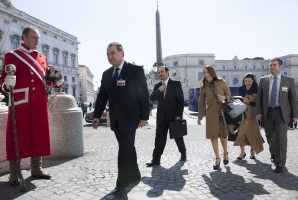
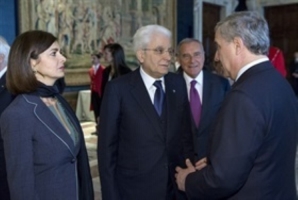
I am particularly pleased - and honoured - to receive at the Quirinale Palace, only a few days before the 60th anniversary of the Treaties of Rome, the Presidents of such a large number of legislative Assemblies of the Member States of the Union, together with the top-ranking officials of the European Institutions.
This anniversary falls in a moment that is particularly complex in the light of the challenges - external and internal - that the Union is forced to meet and that add on to, and at the same time condition, the delicate debate on the relations between Member States and European Institutions and between these and the citizens of the Union.
In this context, in these last 60 years along the path towards European integration, the issues that have experienced a clear and positive development include the democratic consecration of the Union.
From an Assembly consisting of the expression of national Parliaments, we have progressed to the direct election of the European Parliament by the people.
At the same time, we have witnessed the development of an autonomous European dynamic that - on the eve of the last elections to renew the Assembly of Strasbourg - saw different political "families" indicate their respective candidates for President of the European Commission.
It was a meaningful evolution towards the firm reinforcement of the Union's democratic nature.
However, we cannot yet consider it a finished process.
Honourable Presidents,
The transformation that has characterised the Strasbourg Assembly does not only issue from parliamentary practice.
It is something deeper that draws lymph from common roots, from our common culture, from our peoples' shared heritage of principles and sensitivities.
It is an evolution that shows how our Continent is truly a common homeland, embedded with the values and ideas that have forged its identity and that remain deeply nestled in the common conscience of Europe.
At the heart of this is the loftiest expression ever elaborated by Western thought: representative democracy. It is a value with which we all firmly and indistinctly identify: a value that has been staunchly recalled ever since the Copenhagen Declaration on European Identity of 14 December 1973.
It is an unparalleled heritage that constitutes a significant contribution that Europe has made and continues to make towards the progress of all the communities on our Planet.
We Europeans identify with our democracy and all our people together form the European demos that has been emerging and affirming itself in these last few years.
Honourable Presidents,
The double democratic legitimisation enjoyed by European Institutions - that of simultaneously being a Union of citizens and of Member States - imposes however precise responsibilities.
Firstly, that of contributing, through their daily work, to reinforce and harmonise the two levels of expression of our democracy: the one inside the single States and the one that gradually takes shape at European level, in order to make them ever more tightly intertwined.
Never before have we ever had to be so aware that they are the two sides of the same coin, two intimately bound realities.
Inter-parliamentary cooperation is the essential element that daily strengthens the fabric of Europe's democracy.
The plural and fragmented nature of the Union's executive power has its instrument of control and equilibrium in the circuit of the citizens' representative assemblies: an example of this is the supervisory function that the Treaty of Lisbon attributed to national Parliaments on the correct application of the principle of subsidiarity across the Union, as well as the role attributed thereto in promoting policies in the field of justice, liberty and security.
The adoption of the Convention method for reviewing European Treaties - with the direct involvement of national Parliaments - is further proof of this.
We need to strengthen this process, with the aim of completing it, by increasingly enhancing the democratic representativeness of the Union.
We know that the building we have contributed to erect has large margins for improvement, and we must all do our share in making it work better.
Criticisms, sometimes ungenerous and ungrounded, often have their roots in some of the limits in the Union's scope of action that we all have before our eyes.
The Union often replies to the expectations and requests of its citizens by occasionally manifesting its insufficient capacity to respond in a convincing and effective way.
The legitimate ambition to more incisively fulfil the hopes and yearnings of our European fellow-citizens cannot however make us forget that being here today means celebrating sixty years of peace, wellbeing and development unprecedented in our Continent.
Wars in our Continent - of which we fear the renewed risk in some places, also within the Union, evoking this threat to the general public - appear to be extraneous to us, belonging to a remote past, yet they are very recent in terms of historic time.
And the most relevant - decisive - difference between that time and ours is called United Europe.
The Union, with its bond of solidarity, has and continues to contribute to guaranteeing the security of the Countries that compose it.
A Europe primarily built on the free adhesion of peoples, expressed through the Assemblies of the Member States - that you represent - reaches well beyond even widely differing political sensitivities.
A European construction that is permanently subjected to critical evaluation and renovation thanks to the debate that revolves around it.
Honourable Presidents,
In proceeding towards the compelling goal of greater cohesion, we cannot forget that this process is built, day after day, from a variety of traditions and sensitivities that the Union expressly recognises as the original trait of its identity, with the aim of representing a high synthesis of an identical civilisation.
A synthesis that enables Europe to advance.
It is an equilibrium that we are urged to promote and that needs vision, forward-looking responses, capable of enabling us to tackle together the great challenges facing us and which no State of our Continent - not even the strongest - could ever be able to overcome on its own.
In a world increasingly founded on large-scale players, full-fledged institutional giants, Europe cannot surrender its role and its power to influence, making itself ever smaller, translating itself into a minor reality and destining it to be the mere witness of global decisions.
Honourable Presidents,
A celebration such as today's, reminds us of the reasons of sixty years ago, so that we might project them into our future, enriching them with proposals and ideas capable of contributing to creating a better reality for young generations.
We must be proud of these first six decades, aware of the Union's current shortcomings but at the same time certain that the road we have undertaken together is the right one.
With these wishes in mind, let us raise our glasses in a toast to Europe, to our Countries which compose it and to our peoples, who are its active protagonists.